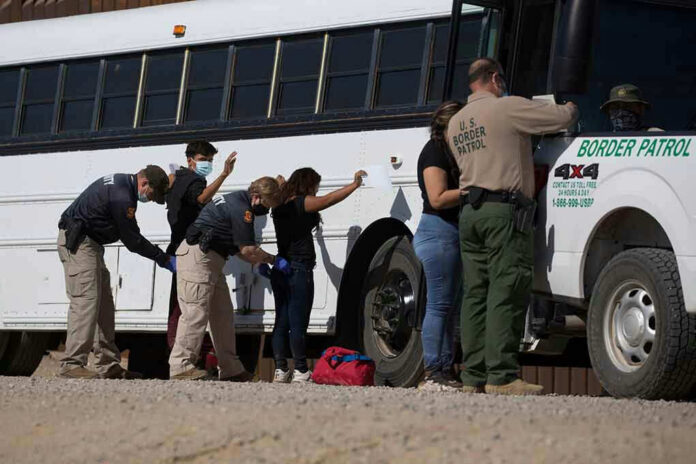
West Virginia just showed what happens when elected leaders stop making excuses and start enforcing the law—more than 650 illegal aliens were arrested in a two-week statewide ICE surge backed by local police.
Quick Take
- ICE’s “Operation Country Roads” ran Jan. 5–19, 2026 and resulted in 650+ arrests across multiple West Virginia cities.
- The operation leaned heavily on 287(g) partnerships, with 14 federal, state, and local agencies working together.
- Officials highlighted arrests involving public-safety concerns, including a convicted child endangerer and a previously removed individual.
- West Virginia officials said the state led the nation in ICE arrests on multiple days, and no protests were reported during the operation itself.
Operation Country Roads: What Happened and Where It Ran
ICE confirmed that “Operation Country Roads” executed a statewide enforcement push from January 5 through January 19, 2026, focusing on people illegally present in the United States and those flagged as public safety or national security risks. Teams deployed to Charleston, Martinsburg, Beckley, Moorefield, Morgantown, and Huntington. ICE and federal prosecutors announced the results January 31, describing a coordinated, multi-agency effort rather than a single-jurisdiction sweep.
ICE and partner agencies publicly described the arrest total as more than 650, while other reporting cited “more than 600,” suggesting rounding or different cutoffs for booking, charging, or transfer into ICE custody. Even with that minor variation, the operational takeaway is consistent: a rural state with a comparatively small immigrant population still produced a high-volume enforcement result when multiple agencies worked the same plan and shared information across jurisdictions.
How 287(g) Partnerships Powered the Surge
West Virginia’s surge relied on the 287(g) program, which allows ICE to delegate certain immigration enforcement functions to trained state and local personnel under formal agreements. State leaders pointed to an August 2025 memorandum of agreement signed by Gov. Patrick Morrisey as a building block for the January operation. Officials also said a post-inauguration executive order directed state law enforcement to cooperate with federal immigration efforts.
Participating partners included the West Virginia State Police, the National Guard, the Division of Corrections and Rehabilitation, and multiple sheriff’s offices and police departments across the state. Officials described 14 total law enforcement partners. West Virginia State Police leadership also told lawmakers that, since September 2025, troopers assisted in roughly 250 ICE arrests “without errors,” an important detail for critics who argue joint enforcement increases the risk of mistaken identity.
Public Safety Examples Highlighted by Officials
Officials emphasized that the enforcement surge was not presented as a paperwork-only exercise. ICE and reporting highlighted specific arrests, including Sagar Singh, an Indian national described as having a prior removal order, taken into custody after a traffic stop linked to “Operation ICE Wall,” a separate enforcement effort focused on commercial drivers. Another highlighted arrest involved Ling Yan, a Chinese national with an Ohio conviction for child endangerment.
Federal authorities also announced immigration charges against eight individuals in Nitro, another example offered to show the operation’s reach beyond the larger cities named in the deployment list. The public messaging from ICE and West Virginia partners centered on community protection: removing people described as repeat immigration violators or individuals with criminal records. The research provided does not include a full breakdown of charges for all arrestees.
Politics, Protests, and the Constitutional Debate
Supporters argued that West Virginia’s model demonstrates what enforcement looks like when state leadership aligns with federal priorities and local agencies are empowered to act. U.S. Attorney Moore Capito said the state led the nation in arrests on multiple days, and local officials praised ICE agents as professional and organized. Notably, reporting indicated no protests occurred during the two-week operation, even though demonstrations were scheduled after the results were announced.
This is what happens when local law enforcement are given the ok to do their job and help ICE. NO ISSUES!!!
ICE arrests over 650 illegal aliens across West Virginia with state, local police backinghttps://t.co/NyweXBe1Pa
— Slugoman (@Slugoman1) February 2, 2026
Criticism still exists, and one outlet raised constitutional and legal concerns tied to immigration raids, referencing court skepticism. Based on the materials provided, that critique is presented more as a warning and policy challenge than as a finding of illegality about this specific West Virginia operation. For conservatives focused on limited government, the key question is whether enforcement stays within statutory authority and due process—while also recognizing that refusing to enforce immigration law shifts costs and risks onto law-abiding communities.
Sources:
W.Va. law enforcement agencies assist ICE in making hundreds of arrests statewide
ICE arrests over 650 illegal aliens across West Virginia with state, local police backing
ICE says more than 600 illegal aliens arrested in West Virginia during 2-week surge
ICE arrests over 650 illegal aliens across West Virginia state local police backing
U.S. Attorney Moore Capito announces success of major immigration operation in West Virginia
ICE arrests surge, court skepticism