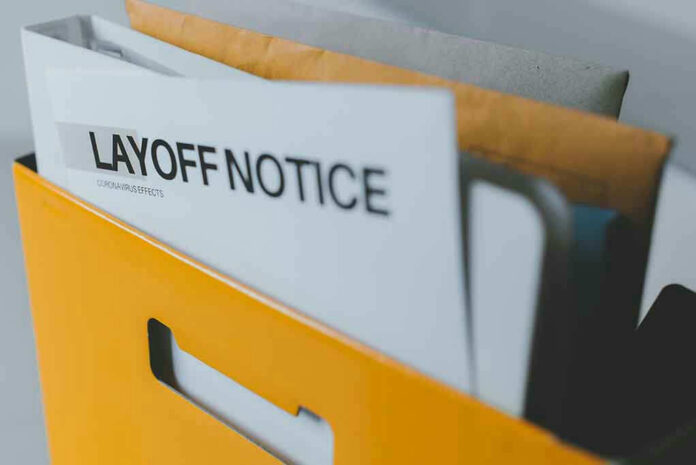
Factory job cuts just jumped back toward financial‑crisis and Covid shock levels, even as Wall Street and global elites blame “AI progress” instead of broken trade, bad energy policy, and years of reckless spending.[4]
Story Snapshot
- U.S. factory job cuts in June hit the worst levels since 2009 and early Covid, even though headline growth numbers look “fine.”[4]
- Artificial intelligence is now the top stated reason for U.S. layoffs, driving roughly 40% of cuts in May and leading for three straight months.[19][21]
- Tech and manufacturing bosses are shedding workers while pouring money into AI and expensive infrastructure, often after years of bad hiring and offshoring.[7]
- Experts admit AI has barely moved productivity, raising fears that “AI” is a cover story for deeper economic weakness and corporate cost‑cutting.[16][17][22]
Factory layoffs spike back toward crisis territory
U.S. manufacturing workers are getting hit hard again, even though the talking heads keep saying the economy is “strong.” A new report from S&P Global finds factory job cuts in June running at levels not seen since the 2009 financial crisis and the first wave of Covid shutdowns in 2020.[4] Manufacturers in three of the last four months have reported cutting staff to deal with weak demand and higher costs, even as headline manufacturing indexes still show growth.[4]
That split tells a story most big media avoid. On paper, S&P’s manufacturing index looks healthy, ticking up to the mid‑50s range, which normally signals expansion.[4] But under the surface, managers are trimming workers because they do not trust the recent bump in orders and they are squeezed by rising raw material and energy costs.[4] For many readers, that sounds a lot like what they lived through after the last crisis: pretty charts for Wall Street, pink slips for Main Street.
AI becomes the number one layoff excuse
At the same time, artificial intelligence has become the number one reason companies give when they cut jobs. Outplacement firm Challenger, Gray & Christmas reports that in May, employers blamed AI for a record 38,579 U.S. layoffs, about 40% of all job cuts that month.[19] That was the third month in a row where AI topped every other reason. A separate television report noted that total announced layoffs in May were over 97,000, the highest May figure since the 2020 pandemic shock.[21]
Through the first five months of 2026, employers have already tied nearly 90,000 planned layoffs to AI, more than all of last year’s AI‑related cuts.[19][21] Tech companies are leading the way. Large firms like Cisco, Oracle, Meta, and others have announced thousands of layoffs while telling investors they are “pivoting” to artificial intelligence and automation.[3][7] One layoff tracker counts more than 120,000 tech job cuts in just the first five months of this year, a 66% jump over the same time last year.[24] For older factory and office workers, it feels like the rug is being pulled out just as they were promised things were finally normal again.
Productivity payoff is tiny, but the damage to workers is real
Many experts now admit that AI has not yet delivered big gains that would justify this wave of job losses. A major analysis from the University of Pennsylvania’s Wharton School found that generative AI raised overall productivity by just 0.01 percentage points in 2025.[11] A separate national survey of leaders by McKinsey reported that 94% of companies saw no meaningful bottom‑line value from their AI projects, even though most had deployed some form of the technology.[16] In short, companies are cutting workers now based more on AI’s promise than its proof.
Manufacturing studies show a similar pattern. Research summarized by the Massachusetts Institute of Technology found that when factories first adopt AI, productivity often drops in the short term as workers and systems adjust.[17] Only after several years do some firms see clear gains in output and market share. That means many of today’s layoffs are happening in the “pain” phase, long before any widely shared benefit arrives. For working families, that is cold comfort. They are being told to sacrifice now for a future that may never trickle down to them.
Is “AI” a cover for deeper economic and political failures?
Some analysts warn that companies are using AI as a clever story to cover up deeper problems. Years of cheap money led many big firms to over‑hire during and after the pandemic.[7] Now demand is softer, borrowing is more expensive, and global competition is fierce. Instead of owning those mistakes, executives can say they are “streamlining for AI” and get rewarded by the stock market. One report notes that when companies announced AI‑driven layoffs, share prices in some cases jumped sharply as investors cheered the cuts.[4]
This “AI‑washing” also helps politicians and bureaucrats dodge blame. If job losses are chalked up to “unstoppable technology,” leaders do not have to answer hard questions about bad trade deals, weak border enforcement, green rules that drive up energy costs, or runaway federal debt that fuels inflation.[4][22] Meanwhile, solid research from Goldman Sachs suggests AI should only cause a mild, short‑term rise in unemployment—about half a percentage point—if handled wisely.[25] That makes today’s silent layoff wave look less like fate and more like a policy and leadership choice.
What conservatives should watch next
For constitutional conservatives, the issue is not the technology itself. Americans have always invented and adapted. The concern is who pays the price and who makes the decisions. Unelected global groups like the World Economic Forum brag that over 40% of employers plan to shrink their workforce because of automation.[2] At the same time, federal agencies and blue‑state governors keep piling on rules that raise energy and compliance costs, pushing factories to cut staff or move offshore while claiming AI made them do it.[4]
Going forward, readers should watch three things. First, whether Washington quietly uses this AI‑layoff moment to push more government “retraining” programs that grow bureaucracy instead of real jobs. Second, whether corporate boards keep linking executive bonuses to AI plans and headcount cuts, not to American jobs and long‑term investment. Third, whether honest data on AI’s true impact gets buried by media that prefer a neat “tech revolution” story over the messy truth about policy mistakes, corporate greed, and the working families caught in the middle.[5][22][23]
Sources:
[2] Web – The AI and labor landscape 2026 – S&P Global
[3] Web – The 2026 AI Job Disruption Report: Which Roles Are Being …
[4] Web – List of Companies Announcing AI-Driven Layoffs – Programs.com
[5] Web – AI Will Reshape More Jobs Than It Replaces | BCG
[7] Web – A.I. Doesn’t Have to Mean Layoffs – The New York Times
[11] Web – AI Productivity Statistics 2025: Gartner, Fed & Real-World Data
[16] Web – AI Productivity’s $4 Trillion Question: Hype, Hope, And Hard Data
[17] Web – Where AI will create value—and where it won’t – McKinsey
[19] Web – [PDF] AI and the Global Productivity Divide: Fuel for the Fast or a …
[21] Web – 59 AI Job Statistics: Future of U.S. Jobs | National University
[22] YouTube – Record layoffs driven by AI: Econ analyst reacts
[23] Web – The Real Job Destruction from AI Is Hitting Before Careers Can Start
[24] Web – How artificial intelligence impacts the US labor market | MIT Sloan
[25] Web – AI-driven tech job cuts hit two-year high, leaving HR leaders to adapt
© totalconservative.com 2026. All rights reserved.