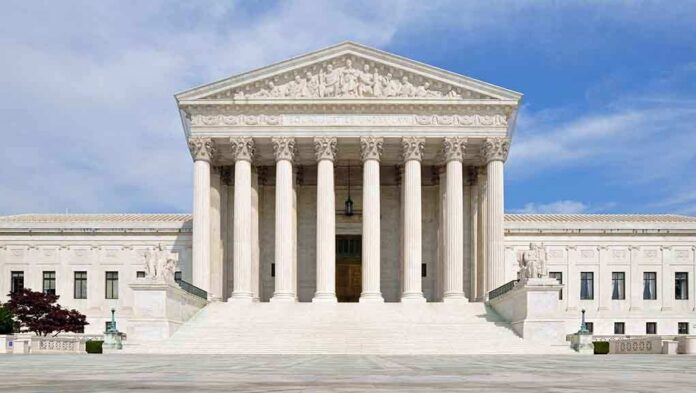
The Supreme Court will decide whether federal law allows mandatory no-bond detention for certain immigrants arrested inside the country, a ruling that could reshape border security and interior enforcement nationwide.
Story Highlights
- The Supreme Court took a case testing habeas challenges to federal immigration detention while removal cases are pending.
- Appeals courts split on whether long-present arrestees face mandatory detention or get bond hearings.
- The Fourth Circuit rejected no-bond detention for interior arrests and required access to bond hearings.
- The administration argues Congress authorized mandatory detention for “applicants for admission” without bond.
What The Supreme Court Is Being Asked To Decide
Supreme Court review will address whether a detainee may use a habeas petition to challenge immigration detention when those claims overlap with the person’s removability case. The government’s petition in Trump v. Badar Khan Suri asks the justices to read federal law to channel detention disputes into the immigration process rather than separate habeas actions in district court. The answer decides where these fights happen and how quickly detainees can test custody before a judge.
Another live dispute concerns which detention statute applies when immigration officers arrest someone already living in the United States. The administration argues that Congress labeled these individuals “applicants for admission,” allowing mandatory detention without bond during processing. The government’s Fourth Circuit brief urged affirmance that “all applicants for admission may be detained without bond” under the statute’s plain text. Reuters reported the same position in petitions to the Supreme Court.
Why Lower Courts Split On Bond Hearings
The United States Court of Appeals for the Fourth Circuit held that Section 1226, not Section 1225, governs detention for long-present interior arrestees. That ruling said these detainees must be able to seek release at a bond hearing before a neutral decision maker, rather than face automatic no-bond detention under the arrival framework. The court’s published opinion creates conflict with other rulings and signals that many judges view bond access as required in these circumstances.
Reuters reported that multiple courts, including several courts of appeals and many district judges, pushed back on the government’s no-bond theory, deepening the need for guidance from the Supreme Court. A clean decision from the justices could settle how immigration officers classify interior arrests and whether habeas remains open for detention-only claims that do not resolve removability. Until then, rules differ by region, producing uncertainty for officers, courts, and communities.
What This Means For Border Security And Due Process
Interior arrests often involve people who entered without inspection long ago and later came onto Immigration and Customs Enforcement’s radar. The government says Congress required detention without bond for “applicants for admission” to ensure appearance at hearings and to protect the public during removal proceedings. The Fourth Circuit said that label does not fit long-present interior arrests and that Section 1226’s bond process governs instead, preserving a path to argue for release.
For conservatives, the stakes are clear. Congress wrote strong detention tools after the 1990s crises, and officers need clarity to stop catch-and-release. Mandatory detention for defined categories can prevent flight and protect families from crime during proceedings. But the legal record here is thin on formal agency explanations and data linking bond hearings to higher absconding, which courts notice. The administration can bolster its case by publishing clear statutory analysis and operational evidence that mandatory detention is necessary and effective.
How The Cases Reached The High Court
The Fourth Circuit’s published Lopez Garcia decision rejected the government’s mandatory detention theory and endorsed bond hearings under Section 1226 for interior arrests. That ruling followed expedited briefing and argument, showing how urgent the issue became across the circuit. This decision now stands as direct appellate authority against no-bond detention for long-present arrestees, increasing pressure for a nationwide rule from the Supreme Court.
Trump's immigration detention policy heads to the Supreme Court, where justices he now regrets appointing could decide its fate. https://t.co/NkJCcYnhNb
— Newsweek (@Newsweek) October 1, 2026
The Suri petition adds a second front: whether district courts can hear detention-only challenges through habeas while removal cases continue. The petition asks the Supreme Court to read the jurisdiction statute to bar duplicative litigation when claims overlap with removability, which the government says promotes uniform and efficient enforcement. The justices’ answer will decide if detainees can get faster federal review of custody, or must wait inside the immigration system for relief.
What To Watch Next
Watch for the Court to pick two tracks: jurisdiction and merits. On jurisdiction, the justices could limit habeas access when detention claims tie closely to removability, steering disputes into immigration courts. On the merits, the Court could decide whether interior arrests fall under Section 1225’s arrival rule or Section 1226’s bond framework. A ruling for the government would strengthen mandatory detention and deter flight. A ruling against would require bond access across much of the interior.
Bottom Line For Readers
The question is not whether the United States can detain illegal entrants. The question is which law controls detention for interior arrests, and where detainees can challenge custody. The Supreme Court’s answer will shape whether officers can hold certain arrestees without bond to protect communities, or whether many more must get bond hearings that can lead to release while cases continue. Clear rules and firm enforcement remain vital to sovereignty and safety.
Sources:
sfgate.com, courthousenews.com, courtlistener.com, ca4.uscourts.gov, supremecourt.report, immigrantjustice.org
© totalconservative.com 2026. All rights reserved.