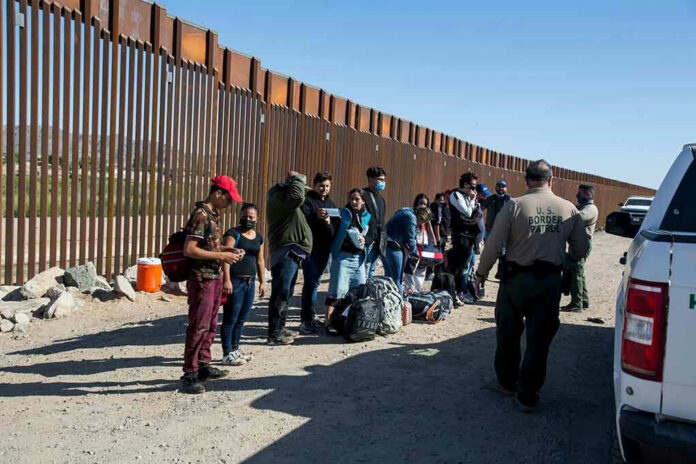
The Supreme Court’s ruling gives President Trump a major border win and puts asylum activists on the defensive.
Quick Take
- The Court allowed immigration officials to block migrants who are still on the Mexico side of the border.
- The ruling revives a policy known as metering, which was rescinded in 2021.
- Lower courts had blocked the policy, but the Supreme Court sided with the administration’s reading of federal law.
- Advocacy groups are expected to keep fighting the decision in court.
What the Court Decided
The Supreme Court said migrants must physically enter the United States before they can claim asylum at the border. That ruling backs the Trump administration’s argument that officials may turn away people who show up at ports of entry but have not crossed onto U.S. soil yet. Reports said the decision covers a long-disputed policy known as metering, which federal officials used to limit asylum access at busy border crossings.[3][6]
The case reached the Court after years of lower-court fights over whether federal law protects people who present themselves at the border from the Mexican side. The administration argued that the word “arrives” does not include someone still outside the country. Media coverage noted that the Court’s conservative majority accepted that view, giving the White House broader room to control who can start the asylum process.[1][2][7]
Why Supporters See It as a Win
For supporters of tighter border control, the ruling is simple common sense. If someone has not entered the country, the government says it does not have to start the asylum process. That view matches a long-running conservative argument that the border must mean something and that courts should not force officials to process every person who reaches the line but remains outside it.[3][8]
The decision also fits a broader pattern the Court has shown in immigration cases. In past disputes, the justices have often given the executive branch room to manage entry rules, especially when Congress has not updated the law clearly. That history matters here because the Court’s reading strengthens the president’s hand on border enforcement instead of letting activist judges run the policy from the bench.[8][13]
What Opponents Are Likely to Do Next
Immigration advocacy groups already argue that turnbacks violate federal law and expose migrants to danger. They say asylum protections should apply when a person reaches a port of entry, even before formal entry into the country. Those groups have kept litigation alive for years, and the Court’s ruling is unlikely to end the political fight over border enforcement or the larger battle over immigration control.[4][5][6]
JUST NOW: US Supreme Court deals MASSIVE BLOW to activist judges by allowing the Trump administration to BLOCK "asylum seekers" from entering America
"If you have to arrive in the US to start an asylum proceeding or an asylum claim. What if you're held on the side? You're not… pic.twitter.com/BKHtYsgnlC
— The Jewish Voice (@TJVNEWS) June 25, 2026
The practical effect may still depend on how quickly federal agencies act and whether other court orders leave room for more challenges. Reports before the ruling noted that earlier decisions had blocked the policy and that the legal landscape remained fluid because of stays and pending appeals. Even so, the Supreme Court’s action gives the administration a strong legal foundation to keep using turnbacks as a border tool.[2][4][9]
Why This Matters Now
This ruling matters because it touches more than one policy fight. It affects border control, asylum law, and the broader question of whether the executive branch can enforce immigration rules without constant judicial interference. For many voters who want a secure border, the Court’s decision is a welcome correction after years of open-border pressure, legal delays, and rules that made enforcement harder than it should have been.
Sources:
[1] Web – BREAKING: Supreme Court Sides with Trump, Allows Immigration Officials …
[2] Web – [PDF] RAICES v. Noem, No. 25-5243 – United States Court of Appeals
[3] Web – Border Restrictions and Court Orders 2017-2026
[4] Web – Supreme Court Rules Defunct Border Turnback Policy Is Lawful
[5] Web – Mullin v. Al Otro Lado | Center for Gender and Refugee Studies
[6] Web – Challenging Unlawful “Turnbacks” of Asylum Seekers at the Border
[7] Web – Supreme Court Today: Immigration Advocates Tell Justices Trump’s …
[8] Web – The Supreme Court Hears Asylum Turnback Case: What You Need …
[9] Web – How the Supreme Court is Shaping Immigration Policy
[13] Web – Federal Appeals Court Rules Trump Proclamation Eliminating …
© totalconservative.com 2026. All rights reserved.