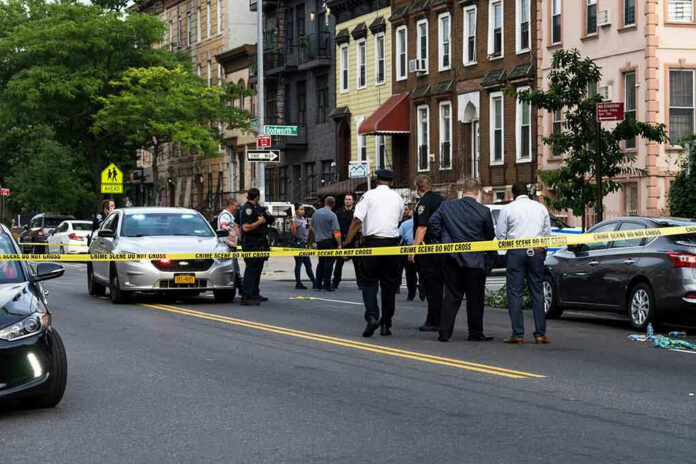
A small Italian city watched an ordinary Saturday afternoon turn into a textbook example of how fast a sidewalk can become a battlefield—and how slowly the truth about what happened actually arrives.
Story Snapshot
- A compact Citroën C3 jumped a Modena sidewalk and smashed through pedestrians before hitting a shopfront, leaving several badly injured.[1][2]
- The driver reportedly tried to stab a man who chased him, raising the specter of a deliberate attack.[1][2]
- Police detained the suspect but publicly kept “accident versus deliberate” open, fueling competing narratives.[1]
- Media headlines raced ahead of investigators, while key evidence—video, toxicology, crash data—remained out of public view.[1][2][3]
How A Normal Street Turned Into A Crime Scene In Seconds
Witnesses in Modena describe a familiar modern horror script: a small car accelerates, veers off its expected path, climbs the curb, and starts using the sidewalk as a lane.[1][2] Pedestrians on Via Emilia, a central shopping artery, suddenly became obstacles. Reports say the Citroën C3 hit a bicycle, then smashed head-on into a woman whose legs were crushed, before plowing onward into others and finally demolishing a shop window.[1][2] Seven people were confirmed injured, with four in serious condition.[1][2]
That basic sequence—curb, bodies, glass—is not contested. Local outlets and international coverage converge on those core facts, down to the count of seriously wounded victims and the car model.[1][2] Where the story fractures is on the question that matters most for public safety and justice: did the driver lose control, or did he choose the sidewalk? Some accounts say he “aimed for” pedestrians; others repeat the mayor’s caution that investigators still have not confirmed intent.[1][2] This uncertainty sits at the center of the Modena debate.
Chase, Knife, And The Question Of Hostile Intent
After the crash, the driver reportedly did not sit dazed behind the wheel or wait to explain himself to police. Reports say he abandoned the wreck, tried to flee on foot, and was chased by bystanders who refused to let him disappear into the crowd.[1][2] At that point, several outlets say he pulled out a knife and either tried to stab, or at least swung toward, a man attempting to stop him before being overpowered and arrested.[1][2][3] That post-crash behavior strongly shapes public perception of intent.
From a common-sense, conservative perspective, the combination of ramming a crowded sidewalk and allegedly brandishing a knife against a citizen trying to restrain him looks far less like a traffic mishap and far more like an attack.[1][2] Ordinary drunk drivers usually cling to their cars and excuses, not blades. Yet the record still lacks critical pieces: no public charging documents, no detailed police statement confirming the stabbing attempt, and no toxicology or mental-health findings.[1] Those gaps matter because, in a society that respects due process, we do not convict by headline alone.
Media Narratives, Official Caution, And A Trust Gap
Journalists worldwide know that “man drives into pedestrians, then chases people with knife” will outrun any sober headline about pending investigations.[2][3] Outlets emphasized the most alarming storyline, some framing the act as deliberate in the title while noting police uncertainty deeper in the text.[1][2] That split-screen presentation—certainty in bold, caution in fine print—invites cynicism. Citizens see vivid footage and emotional commentary long before they see forensic diagrams or prosecutor briefs.
Car rams into pedestrians in Modena Italy, injuring 8, and four are in a serious condition.
It has been reported that the driver attempted to flee but was stopped by locals and is now in police custody.
Witnesses also say the man was holding a knife.
https://t.co/Q0AEiBkjeW pic.twitter.com/I3oQXCUL7M— Patriotic 🇬🇧 Nation (@HoodedClaw1974) May 16, 2026
Italian authorities, by contrast, signaled the standard modern posture after a mass-casualty crash: everything from accident to deliberate action remains on the table until evidence narrows it down.[1] That restraint aligns with the rule-of-law instinct not to prejudge motive, especially when details about the suspect’s background, possible intoxication, or mental state remain unverified.[1] Yet to many observers, especially when reports stress the driver’s foreign or North African origin, official caution can sound like evasion instead of prudence.[1][2]
Why Intent Is Hard To Prove And Easy To Exploit
Vehicle-into-pedestrian incidents now sit in a grim global category where one visible pattern—car, crowd, panic—can mask very different realities. Forensic experts know that proving intent requires more than video of impact; it demands reconstruction of steering inputs, braking, speed, and any medical or chemical factors affecting the driver. Eyewitnesses might swear the car “aimed” at people, but an epileptic seizure or catastrophic mechanical failure can produce equally violent paths. In Modena, none of that technical evidence is yet public.
That evidentiary gap creates an opening—for activists, opportunistic politicians, and sometimes even foreign propagandists—to project their preferred narrative onto the crash. Some will seize on the suspect’s origin and alleged knife to fold the case into a broader story about migration and public safety. Others will highlight police caution to argue that media dramatized what might be intoxicated or erratic driving.[1][2] American conservative values counsel something less hysterical and more demanding: insist on full transparency, release of video and reconstruction data, and serious charges if intent is proven, while rejecting both instant exoneration and instant demonization.
What A Serious Society Should Demand Next
A serious response to the Modena incident does not stop at sympathy tweets or viral clips. Citizens should expect authorities to preserve and, where possible, release municipal and storefront footage, emergency dispatch audio, and detailed crash reports.[1] Prosecutors should clarify whether a knife was recovered, whether any stabbing injuries occurred, and what charges the evidence supports. If investigators confirm deliberate targeting, the public deserves firm prosecution; if they conclude catastrophic impairment or medical crisis, the public deserves a transparent explanation anchored in hard data.
For readers outside Italy, Modena is a reminder that law and order requires both courage and patience. Bystanders displayed courage when they chased down a dangerous driver and reportedly disarmed him.[1][2] The system must now show patience with facts, not feelings, while refusing to hide behind ambiguity if the evidence ultimately points to a chosen path up onto that sidewalk. Freedom to walk a city street without being mowed down by a car is basic. So is the freedom not to be convicted by rumor. Modena sits at that crossroads until the full record comes out.
Sources:
[1] Web – Horror in Modena as car rams into pedestrians on busy Italian street
[2] Web – Video: Man Drives Into Pedestrians, Then Chases People With Knife …
[3] YouTube – Man Drives Into Pedestrians, Then Chases People With Knife In Italy