
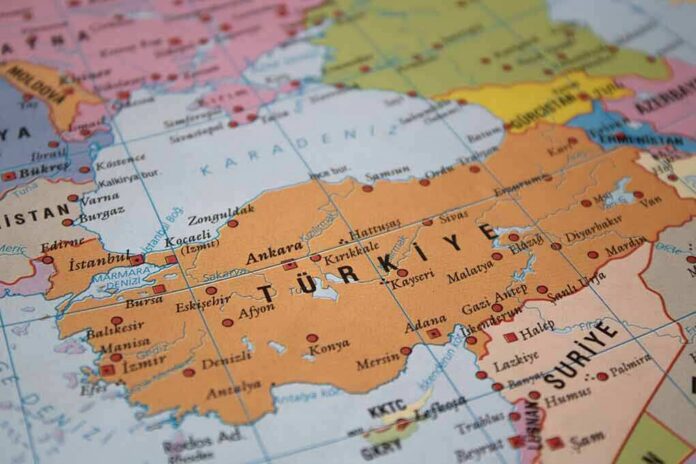
Turkey and China signed a renewable-energy memorandum that targets about $15 billion for power, storage, and grid projects at COP31 in Antalya.
Story Highlights
- Turkey’s energy minister announced a memorandum with China’s energy authority at COP31.
- The plan targets about $15 billion to add 7,000 megawatts of wind and solar.
- The scope includes new energy storage and 4,000 megawatts of transmission lines.
- The deal is a memorandum of understanding, not a final financing contract.
What Turkey and China Signed in Antalya
Turkey’s Energy and Natural Resources Minister Alparslan Bayraktar said Turkey and China’s national energy administrations signed a memorandum of understanding during the COP31 summit in Antalya. He said the plan aims to channel about $15 billion into renewable power, storage, and grid links. The minister outlined a goal to build wind and solar plants with a combined capacity of 7,000 megawatts. He also cited new energy storage systems and added electricity transmission capacity as core parts of the plan.
Bayraktar’s statement placed transmission upgrades at 4,000 megawatts of capacity and tied the full package to China’s National Energy Administration as the counterpart. Multiple outlets carried the same core figures and scope on the same day, including the headline investment value, the 7,000 megawatt target for generation, and the storage and grid components. That consistency strengthens the basic facts of what was announced at the summit in Turkey.
Scope: Power Plants, Storage, and Grid Links
The generation target centers on 7,000 megawatts of wind and solar capacity. That is roughly the scale of several large utility wind zones and many mid-size solar parks. The plan also references energy storage systems. Those systems help balance the grid when wind and sunlight change through the day. The package further points to 4,000 megawatts of new transmission capacity, which would move power from new plants to cities and factories across Turkey.
Officials did not release a list of plant locations, designs, or a build schedule. They did not name Chinese companies, banks, or developers that would fund or construct the assets. They also did not share the terms for ownership, permits, or power sales. Those project-level details often come later, after regulators, lenders, and builders work through engineering and finance steps. For now, the memorandum sets aims, not final contracts or disbursements.
How This Fits a Bigger Global Trend
Many governments now announce large clean-energy packages first, then sort out financing and execution. This deal aligns with that pattern. The $15 billion and 7,000 megawatt figures show policy ambition and investment intention. They do not yet show committed capital. Turkey and China have worked together on energy for years, and China has shifted more of its overseas efforts toward renewables, storage, and grids. That shift has grown across many emerging markets since the mid-2010s.
Turkey, China sign MOU paving way for $15 bn renewable energy investment https://t.co/rfhYEAHdmr
— Turkish Minute (@TurkishMinuteTM) November 12, 2026
For citizens watching power bills and energy security, the stakes are concrete. New wind and solar can cut fuel imports and bring more stable prices once built. Storage makes those gains more reliable. New transmission prevents bottlenecks that waste clean power. But progress depends on permits, land, grid studies, and finance. A memorandum opens the door. Real relief for households and small businesses arrives only when shovels hit the ground and electrons flow.
Sources:
insiderpaper.com, reuters.com, dailysabah.com, ilkha.com
© totalconservative.com 2026. All rights reserved.