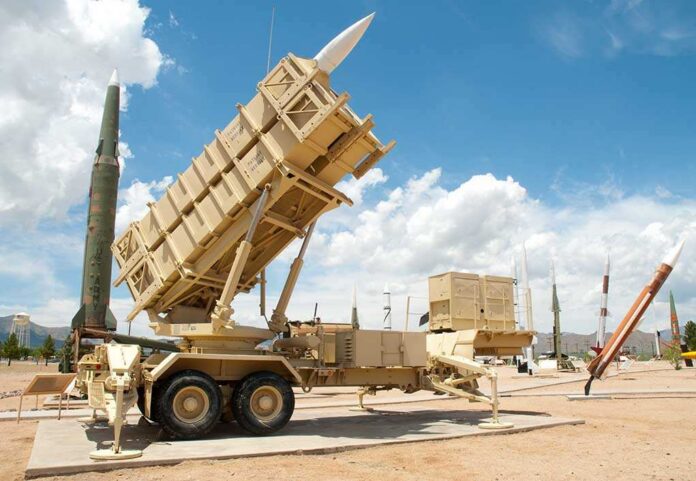
As wars abroad burn through high‑end missiles, the United States now faces a years‑long gap in its own defenses that neither party in Washington seems willing or able to fix quickly.
Story Snapshot
- Experts say refilling key Patriot and Terminal High Altitude Area Defense missile stocks will take about three years or more, even with new contracts.
- Think‑tank estimates show Patriot and Terminal High Altitude Area Defense inventories will not return to pre‑Iran war levels until around 2029–2030.
- President Trump’s move to license Patriot production to Ukraine highlights how strained U.S. and allied missile factories already are.
- Production bottlenecks and years of under‑ordering have created a “window of vulnerability” that worries both hawks and skeptics of endless wars.
Missile stockpiles drained faster than they can be rebuilt
U.S. forces fired large numbers of Patriot and Terminal High Altitude Area Defense missiles during the recent Iran war and related operations, and those interceptors are not easy to replace. Analysts interviewed by Task & Purpose say it will take about three years, and likely longer, to rebuild Patriot and Terminal High Altitude Area Defense stocks to pre‑war levels, even if fighting stops today and production lines stay busy the whole time. One expert called three years the “most conservative” estimate and warned the real number could be higher.
Defense researchers at the Center for Strategic and International Studies reached similar conclusions using Pentagon delivery data. Their work shows Patriot and Terminal High Altitude Area Defense missiles will need “three or more years” of new deliveries just to get back to pre‑war inventories, assuming no new major conflict drains the shelves again. These are not simple bullets you can stamp out like widgets; each interceptor is a complex weapon with advanced electronics, sensors, and rocket motors that take time to build and test.
A multiyear “window of vulnerability” the Pentagon admits
Former Marine officer and defense analyst Mark Cancian, who helped write the Center for Strategic and International Studies study, says the United States now faces a multi‑year “window of vulnerability” as it waits for new missiles to arrive. If another major war breaks out in the next few years, especially in the Western Pacific against a country like China, U.S. commanders would be forced to fight with thinner missile shields than they planned. That risk exists even after Congress approved huge defense budgets and new contracts intended to boost production.
The Department of Defense has started a long‑term plan to refill missile stockpiles drained by Iran and other crises, but that plan stretches into the next decade. A government contracting summary notes that, despite record funding for systems like Tomahawk, Patriot, Standard Missile, and Terminal High Altitude Area Defense, full restocking may not complete until roughly 2029–2031 because factories and suppliers cannot expand overnight. In plain terms, the money is there, but the machines, people, and raw materials take years to scale up.
Production bottlenecks and years of under‑ordering
Defense experts point to two main reasons for the slow rebuild: tight production capacity and past decisions to order too few missiles for peacetime savings. Center for Strategic and International Studies data show that, even before the Iran war, new Patriot and Terminal High Altitude Area Defense orders required 34 to almost 40 months from funding to first delivery. That timeline has now stretched further because the same limited assembly lines must serve U.S. needs plus large foreign orders from allies who also worry about Iran, Russia, and China.
Media reports describe how, in some years, the United States bought only a few dozen Terminal High Altitude Area Defense interceptors and just a couple hundred Patriot missiles. At those “normal” rates, it would take many years to reach new targets for bigger stockpiles. Analysts warn that Washington treated missile inventories like a checking account that never needed a cushion. When real wars hit, the account drained much faster than planned, exposing how fragile the supply chain had become.
Licensing Patriot production to Ukraine shows the strain
President Trump’s decision to grant Ukraine a license to build Patriot interceptors is meant to help Kyiv defend itself and also spread out production over time. He announced at the NATO summit that “we’re going to give a license to you to make Patriots,” confirming that Washington is willing to share sensitive technology rather than rely only on U.S. factories. Ukrainian President Volodymyr Zelenskyy said the two countries reached a “political agreement” and that technical teams should move quickly to turn it into real production.
The Iran war depletion point is fair, but that is exactly why the license matters. It shifts production to Ukraine so US stockpiles stop being the bottleneck. Trumps past betrayals are real, but the Patriot deal is signed and the $400M is budgeted.
— medoyid_ua (@LetsArmUKR) July 30, 2026
But news outlets that spoke with experts and industry officials say Ukraine’s Patriot plants will not solve near‑term shortages for anyone. The Associated Press reports that turning the license into working factories and finished interceptors will likely take years, not months, because of export‑control rules, complex tooling, and the need to train a skilled workforce. Defense News adds that key details of the co‑production deal, such as exact timelines and division of work with U.S. contractors, remain undecided. In other words, the license is a long‑term bet, not a quick fix.
Hawks, doves, and everyday Americans see the same problem
Security hawks worry that depleted missile defenses invite trouble. Military analysts warn that if the United States had to fight another large war soon, it might “run out of missiles” for key defense systems, especially if usage matched the intense pace seen against Iran. One expert told Military Times that “you can’t replace those kinds of missiles overnight” and that it would “take years,” echoing what many in the think‑tank world now say. That kind of risk cuts against the idea of “peace through strength” many conservatives support.
At the same time, many liberals and independents look at these timelines and see another problem: a defense machine that burns through billions of dollars yet still leaves the country less safe for years. They ask how Washington can spend over a trillion dollars a year on defense and still end up short on basic protection for troops and cities. Both sides see an elite system that ignored warnings about supply chains, chased short‑term savings, and then scrambled once the bills came due, leaving regular Americans stuck with the risk and the cost.
What this says about Washington and the “deep state”
The missile shortfall fits a pattern that many Americans on both left and right now recognize. Leaders from both parties talk tough on national security, but they allowed the missile‑industrial base to shrink and stretch out delivery schedules over decades. Major contractors enjoyed steady profits while production stayed lean. Congress kept passing short‑term spending bills instead of giving the long, predictable funding streams that complex weapons need. Only after a major war exposed the weakness did the system lurch into crisis mode.
For citizens who already feel Washington serves the rich and well‑connected first, this story confirms their fears. The United States can send advanced weapons around the world in weeks, yet it will take three years or more to ensure American troops and allies have enough interceptors to survive the next big salvo. That is not mainly a problem of engineers; it is a problem of priorities, planning, and a government culture that reacts late and then tells people to trust that everything is under control.
Sources:
taskandpurpose.com, reuters.com, armyrecognition.com, bbc.com, france24.com, defensenews.com
© totalconservative.com 2026. All rights reserved.