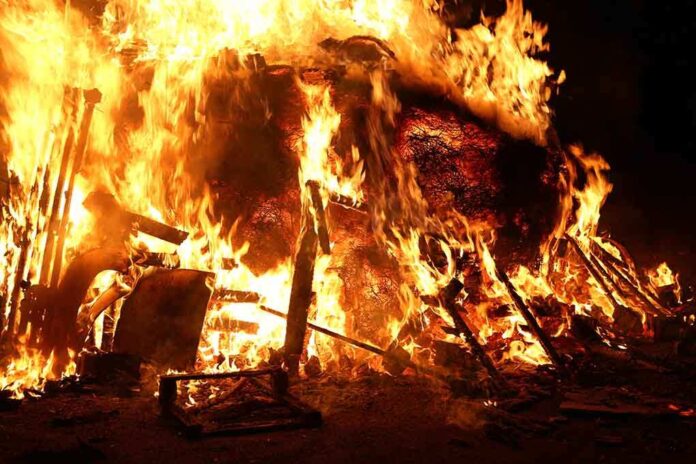
California’s justice system finally takes decisive action as a pro-Hamas arsonist receives a 19-year prison sentence, exposing the ongoing threat of ideology-driven violence on American soil.
Story Snapshot
A California man inspired by the Hamas attack on Israel was sentenced to 19 years in federal prison for firebombing attempts at UC Berkeley and the Oakland federal courthouse.
The case highlights the spread of international terrorism-inspired violence within the United States.
Federal authorities framed the incident as domestic terrorism, prompting stronger security measures and public condemnation.
Law enforcement response was swift, sending a clear message against violent extremism while protecting conservative values.
Arson Motivated by Foreign Extremism Hits Home
Casey Robert Goonan, a 35-year-old California resident, was convicted on federal arson charges after admitting that his attacks on UC Berkeley and the Ronald V. Dellums Federal Building were inspired by Hamas’s October 7, 2023 assault on Israel. Goonan’s targeting of both university and federal property, including placing six Molotov cocktails under a campus police car and attempting to firebomb a federal courthouse, revealed an alarming willingness to bring violent, foreign-inspired activism onto American soil. His explicit calls for others to attack property in support of Palestinians further amplified concerns about the spread of radical ideologies within the U.S.
Law enforcement rapidly apprehended Goonan after his June 2024 attacks, with federal authorities labeling him a domestic terrorist. Judge Jeffrey White, who presided over the sentencing, underscored the severity of Goonan’s actions in the context of rising politically motivated violence. Prosecutors emphasized that Goonan’s conduct went far beyond protected free speech and peaceful protest, crossing into dangerous territory that threatened public safety and undermined the rule of law. The Federated University Peace Officers Association condemned the attacks, characterizing them as “cowardice, hatred, and violence”—a sentiment echoed by community members alarmed by the incident’s implications for campus and federal security.
Political Violence and Constitutional Threats
Goonan’s case is part of a broader trend of political violence in the wake of international conflicts, with U.S. college campuses and federal buildings increasingly caught in the crossfire of ideological battles. The October 7 Hamas attack triggered waves of pro-Palestinian activism and protests across American universities, but Goonan’s leap to arson and attempted firebombings marked a chilling escalation. Such acts threaten not only property and lives but also the foundational principles of American society, including the right to peaceful assembly and the protection of law enforcement officers. Federal authorities’ decisive response highlights the urgent need to draw clear boundaries between legitimate activism and criminal conduct that undermines public order and constitutional rights.
The incident exposes vulnerabilities in campus and federal building security, prompting immediate reassessment and strengthening of protocols nationwide. The link between foreign terrorism and domestic extremism has forced policymakers and law enforcement officials to reevaluate how international events can fuel radicalization and violence at home. The conservative community sees this as a direct attack on American values and a wake-up call to reject any agenda that excuses or enables such extremism, reaffirming the importance of defending the Constitution and public safety against ideology-driven threats.
Impact on Community and Policy Responses
The aftermath of Goonan’s sentencing reverberates beyond the courtroom, affecting students, law enforcement, federal employees, and the broader Bay Area populace. The mandated restitution of nearly $95,000 for property damage and a 15-year supervised release period signal the gravity of the offense and the commitment to accountability. In the short term, heightened security measures have been implemented at UC Berkeley and the Oakland courthouse, with a likely chilling effect on campus activism linked to violent rhetoric. Over the long term, the case is expected to raise awareness of domestic terrorism inspired by global events, leading to increased monitoring and preventive strategies by federal agencies.
Law enforcement experts and prosecutors uniformly condemned Goonan’s actions, stressing the need to distinguish between peaceful protest and acts of terror. The swift and firm federal response serves as a deterrent and reassurance to communities that violent extremism will be prosecuted to the fullest extent of the law. For conservatives, the incident validates concerns about the dangers of unchecked ideological activism and reaffirms their call for strong leadership, secure borders, and the preservation of traditional American values in the face of evolving threats.