
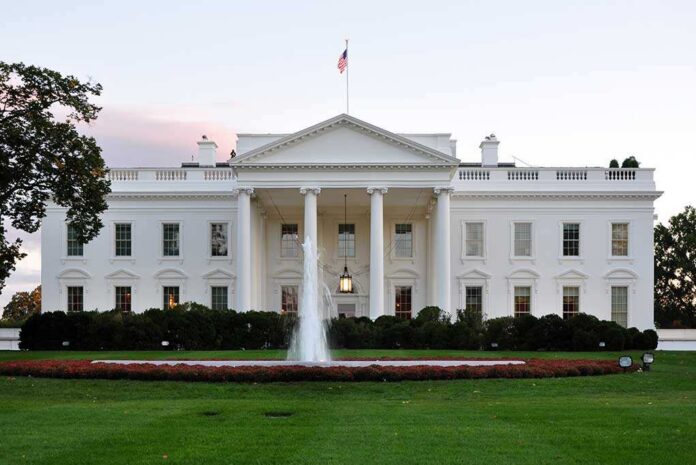
The ballroom Trump just unveiled isn’t what it seems—it’s a sophisticated cover story for a military-grade underground fortress that rewrites how America protects its president.
Quick Take
- Trump disclosed March 29 that the U.S. military is constructing a “massive complex” beneath the new White House State Ballroom, replacing the Cold War-era Presidential Emergency Operations Center.
- The $400 million project is entirely donor-funded with zero taxpayer dollars, completed ahead of schedule and under budget despite cost escalations from initial estimates.
- The ballroom itself features bulletproof glass and drone-proof protections, serving as a surface-level “shed” for the classified underground facility.
- Federal approval came swiftly in February 2026 after the Justice Department invoked national security, with Judge Richard J. Leon allowing construction to proceed despite questions about executive authority.
The Cover Story That Isn’t
When Trump announced a 90,000-square-foot White House expansion in July 2025, the public heard about event space. What emerged instead was a masterclass in strategic architecture. The East Wing, demolished in October after 84 years of service, housed the original Presidential Emergency Operations Center built during the Cold War. Trump’s team didn’t just rebuild it—they reimagined it as something far more formidable, burying the real project beneath a sophisticated ballroom narrative.
The ballroom itself, designed by architect James McCrery II, stretches 22,000 square feet and accommodates 999 guests for state dinners and diplomatic functions. But here’s the critical detail: Trump himself revealed the ballroom serves as architectural camouflage. Speaking aboard Air Force One on March 29, he stated bluntly that “the ballroom essentially becomes a shed” for the underground military complex. This isn’t accidental design—it’s deliberate layering of function and security.
Security Innovation Meets Budget Reality
The security specifications read like science fiction. Bulletproof glass throughout. Drone-proof construction. These aren’t theoretical upgrades; they’re responses to genuine modern threats. The ballroom’s protective features mean state dinners now occur inside a hardened structure, a dramatic shift from traditional White House entertaining. The First Lady gets new offices, staff gains a renovated 42-seat movie theater, and an elegant glass bridge connects the new structure to the Executive Residence.
The financial architecture proves equally innovative. Clark Construction consortium won the primary contract, initially valued at $200 million but revised upward. By October 2025, Trump had raised $350 million from private donors—a figure that eventually reached approximately $400 million. Trump repeatedly emphasized: not one dime from taxpayers. This private funding model bypassed congressional appropriations battles entirely, a strategic advantage that accelerated approvals and reduced political friction.
The Military’s Secret Mission
What lies beneath the ballroom remains classified. Trump confirmed the U.S. military is “building a massive complex” underground, replacing the outdated PEOC with a facility whose specifications the Justice Department guards fiercely. On February 2, 2026, the Justice Department filed court documents invoking national security, effectively shielding project details from public scrutiny. Four days later, Judge Richard J. Leon ruled in Trump’s favor, allowing construction to continue despite earlier questions about presidential authority for such an undertaking.
The timeline suggests urgency. Demolition began in October; approvals came rapidly in February; Trump disclosed the military component on March 29. This compressed schedule, achieved ahead of budget, indicates either extraordinary coordination or pre-positioned planning. The White House director of management and administration, Joshua Fisher, oversees the classified elements, maintaining operational security while the ballroom construction proceeds visibly above ground.
Why This Matters Now
Modernizing presidential security infrastructure isn’t controversial in principle. The original PEOC served faithfully since 1942, most notably sheltering Vice President Dick Cheney on September 11, 2001. What distinguishes this project is its scale, speed, and funding model. A $400 million underground military facility, funded entirely privately, approved through expedited channels citing national security, and explicitly confirmed by the president as separate from the disclosed ballroom—this represents a significant evolution in how America protects its executive branch.
The donor list remains public; individual contribution amounts do not. Capacity revisions climbed from 650 to 999 guests. Cost estimates doubled from initial projections. These fluctuations, while substantial, pale against the project’s completion ahead of schedule. The real story isn’t the ballroom’s beauty or the theater’s restoration—it’s that America just built a new fortress beneath one of its most iconic buildings, and most people still think it’s just a fancy dining room.
https://www.usatoday.com/story/news/politics/2026/03/30/trump-white-house-ballroom-military-shed-construction/89383496007/
Trump’s March 29 disclosure wasn’t accidental. It was a calculated revelation of capability, a signal that presidential security has evolved beyond what Cold War architects imagined. The ballroom will host state dinners. Dignitaries will admire the bulletproof glass, the drone-proof construction, the meticulous design. Few will consider what’s beneath their feet—a military-grade complex whose full specifications remain classified, protecting not just the president, but the nation’s most sensitive security infrastructure.
Sources
Trump says military is building underground complex at White House
US military building ‘big complex’ under White House ballroom: Trump