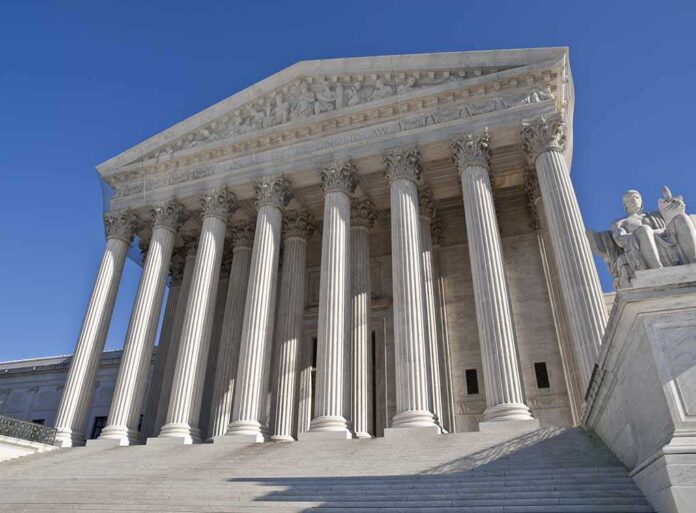
The Supreme Court just delivered a stunning rebuke to Donald Trump, blocking his attempt to deploy National Guard troops to Chicago in a 6-3 decision that saw three conservative justices break ranks to join the liberal wing.
Story Highlights
- Supreme Court blocks Trump’s National Guard deployment to Chicago in 6-3 ruling on December 23, 2025
- Three conservative justices—Roberts, Barrett, and Kavanaugh—joined liberal justices against Trump
- Court ruled Trump’s order exceeded federal authority and violated constitutional federalism limits
- Illinois successfully argued the deployment was unnecessary and violated state sovereignty over Guard units
Constitutional Clash Over Federal Power
Trump invoked federal authority to deploy Illinois National Guard units to protect ICE facilities and assist immigration enforcement in Chicago, despite fierce opposition from state officials. Illinois Governor and local Chicago leadership sued immediately, arguing the move violated constitutional federalism principles and exceeded presidential authority under the Insurrection Act. The dispute centered on whether Trump could commandeer state military resources for contested federal immigration policies without meeting statutory requirements for domestic troop deployment.
The Seventh Circuit Court of Appeals initially blocked the deployment, prompting Trump’s emergency appeal to the Supreme Court. Legal experts noted the rare nature of using the Insurrection Act, which typically requires evidence of actual insurrection, domestic violence, or complete breakdown of state law enforcement capabilities. Illinois argued none of these conditions existed in Chicago.
Unlikely Coalition Emerges on High Court
The most striking aspect of Trump v. Illinois was the judicial coalition that emerged to stop the deployment. Chief Justice Roberts joined Justices Barrett and Kavanaugh—both Trump appointees—with the court’s three liberal justices to form the decisive six-vote majority. This alignment shocked court watchers who had grown accustomed to Trump prevailing on the court’s emergency docket, often called the “shadow docket.”
Justices Thomas, Alito, and Gorsuch dissented, suggesting they would have allowed the deployment to proceed. The majority opinion emphasized that domestic deployment statutes must be construed narrowly to avoid normalizing military involvement in civilian law enforcement. The decision reinforced anti-commandeering doctrines that limit federal authority to compel state cooperation in contested policy areas.
States Rights Advocates Claim Victory
The ACLU immediately hailed the ruling as a “critical victory for democracy and the rule of law,” arguing it prevented dangerous expansion of presidential authority to use military force for domestic political purposes. Civil liberties groups had warned that allowing the deployment would set a precedent for future administrations to militarize local law enforcement disputes whenever federal and state officials disagreed on policy priorities.
The decision strengthens governors’ bargaining power against federal overreach while establishing higher evidentiary standards for future domestic Guard deployments. Legal scholars noted that presidents of either party will now face stricter scrutiny when attempting to override state objections to military deployments, particularly when alleged threats relate to policy disagreements rather than genuine security crises threatening constitutional order.
Sources:
ACLU Statement on Supreme Court Blocking President Trump’s Troop Deployment to Illinois
Trump v. Illinois Supreme Court Opinion