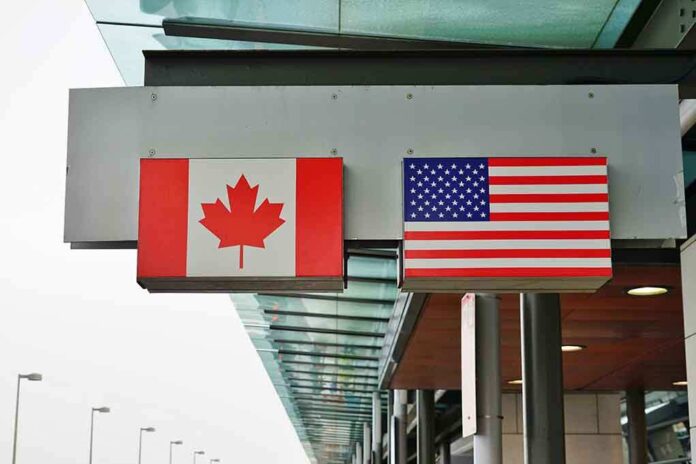
Canada will not crumble overnight, but one bad move on trade or housing could quietly lock the country into a decade of decline that feels an awful lot like collapse from the kitchen table up.
Story Snapshot
- Canada’s real risk is not sudden ruin, but a grinding, low-growth stagnation that erodes living standards and fuels anger.
- The 2026 CUSMA/USMCA review is the single biggest external trigger that could slam exports, jobs, and the dollar.
- Housing, debt, and productivity weakness mean Canada enters that moment already economically fragile.
- Conservative, common-sense priorities—sound trade, disciplined debt, and real productivity reforms—will decide whether Canada drifts or rebounds.
How “Collapse” Really Happens In A Modern Country
Collapse in a modern, advanced economy rarely looks like headlines suggest. Canada does not suddenly wake up as Argentina after a weekend summit goes sideways. Instead, residents feel collapse as a slow tightening: paycheques that do not keep up, taxes that rise faster than services improve, kids who quietly conclude they will never own a home, and a business climate where investment trickles elsewhere. That is the real danger analysts see when they talk about Canada’s risk profile for 2026 and beyond.
Forecasts from major banks and consultancies still show positive growth in 2026—roughly one to just over two percent real GDP—rather than outright contraction. On paper, that sounds fine. In real life, for families already squeezed by mortgage payments and grocery bills, “one percent growth” feels indistinguishable from standing still. When the cost of living climbs faster than opportunity, voters stop caring about technical definitions and start asking tougher questions about whether the system works at all.
The Trade Trigger That Could Shock The System
The 2026 review of the Canada–United States–Mexico Agreement is the key external threat that turns a slow grind into something sharper. Roughly three-quarters of Canadian exports flow to the U.S., an extraordinary concentration of risk for any advanced economy. If that preferential access is compromised—through higher tariffs, quotas, or an outright breakdown—exporters, manufacturing regions, and the Canadian dollar would feel the hit first, and households would not be far behind.
The Bank of Canada has already described the coming CUSMA review as a “significant risk,” a rare phrase from an institution that usually chooses its words like a surgeon picks instruments. Business investment is expected to be held back until the review outcome is clearer, because no rational firm ramps up long-lived projects into tariff uncertainty. For conservatives who value stable, rules-based trade, this is the kind of uncertainty government should be burning political capital to reduce, not taking for granted as background noise.
Housing, Debt, And The Affordability Squeeze
While trade is the big external swing factor, housing and debt are the internal fault lines that could amplify any shock. Canada has spent two decades inflating a housing market where price-to-income ratios and household debt levels are among the highest in the developed world. Cheap money, restricted supply, and persistent demand turned homes into leveraged financial assets first and shelter second. When rates rose to fight inflation, that bet suddenly looked less clever for overextended households.
Analysts now describe affordability as a crisis that drags on consumer confidence and political stability. Heavily indebted homeowners are exposed to renewals at higher rates, while renters in major cities face escalating costs without the consolation of equity. From a common-sense conservative lens, this reflects years of policy that favoured financial engineering over building more supply and letting prices reconnect with incomes. If a trade or financial shock hits a population already this stretched, the social reaction could be far more volatile than the GDP numbers alone suggest.
Productivity, AI, And The Quiet Erosion Of Prosperity
The other unglamorous but decisive factor is productivity. Canada has struggled to keep pace with U.S. and peer economies in output per worker and business investment. That gap matters because productivity is the engine that funds everything else: tax revenues, health care, pensions, and the ability to absorb shocks without permanent damage. Without stronger productivity, the country can only support its promises through higher taxes, more debt, or cuts that provoke political backlash.
Analysts highlight both promise and peril in AI and financial markets. AI-driven firms and infrastructure investments could raise productivity if they spread beyond a few urban clusters. At the same time, the Bank of Canada warns that overextended bets in high-flying tech names or leveraged plays on AI could unwind suddenly, threatening broader financial stability. If Canada wants AI to be an engine, not a bubble, policy needs to reward real innovation and diffusion, not speculative froth.
What A Conservative, Common-Sense Response Looks Like
The data-driven outlook from banks and economists does not support the YouTube fantasy of a country imminently collapsing into chaos. It does, however, support a more uncomfortable conclusion: Canada is coasting on old advantages—U.S. market access, resource wealth, and a reputation for stability—while accumulating structural weaknesses in housing, debt, and productivity that reduce its margin for error. A bad outcome in the 2026 CUSMA review, layered onto these vulnerabilities, would feel like sudden decline to many citizens.
A conservative, common-sense approach starts with priorities already implicit in the research: protect and deepen rules-based trade with the U.S. and Mexico; restore fiscal discipline to rebuild shock absorbers; remove barriers to building housing and productive infrastructure; and focus AI policy on real economy gains rather than headline-chasing. Canada does not have to collapse. But if leaders treat 2026 as just another year, the country may quietly choose stagnation without ever formally voting for it.
Sources:
Beyond the forecast: Six themes for Canada’s economy in 2026 (RBC Economics)
Canada’s market rally enters 2026: Growth ahead, gains may be tamer (Morningstar)
Economic outlook for 2026 (RSM Canada)
The Canadian economy faces 3 risks in 2026 (Financial Post)
Canadian economic outlook for 2026 (BDC)
Canada economic trends 2026 (RBC Investor & Treasury Services)
Canadian dollar is poised to climb higher against US dollar, barring trade risk (Morningstar)