A single executive order has the Supreme Court weighing whether any president can rewrite a 150-year constitutional rule—and millions of Americans are now watching what that means for the 14th Amendment.
Quick Take
- The Supreme Court heard April 1, 2026 arguments over President Trump’s executive order limiting birthright citizenship for certain U.S.-born children.
- Lower courts have repeatedly blocked the order, and the justices are now reviewing the case on the merits.
- ACLU lawyers argue the order would deny citizenship to thousands of U.S.-born babies whose parents lack permanent legal status.
- Trump’s team argues the 14th Amendment was intended more narrowly, while challengers point to long-standing precedent and federal practice.
What the case is—and why Trump’s presence mattered
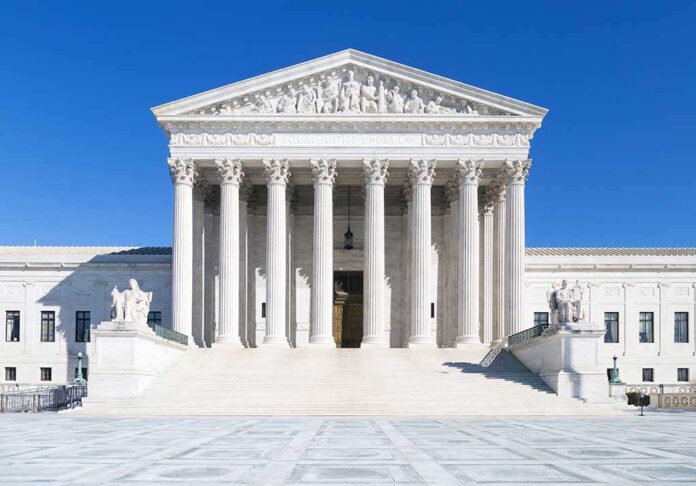
President Trump attended the Supreme Court on April 1, 2026 as justices heard arguments challenging his executive order restricting birthright citizenship, then departed during the proceedings as the challengers emphasized the number of children they say would be affected. The order, signed on January 20, 2025, targets children born in the United States after February 19, 2025 to parents without permanent legal status. Federal courts have blocked it so far.
For conservative voters, the fight lands in a familiar tension: border enforcement versus constitutional limits. Many Americans who backed tougher immigration policy also expect the separation of powers to mean something in practice. The key legal question is not whether the U.S. should deter illegal immigration, but whether a president can do it by executive order in an area courts have long treated as controlled by constitutional text, precedent, and Congress’s immigration framework.
The legal fault line: 14th Amendment text versus executive power
Birthright citizenship traces to the 14th Amendment’s citizenship clause: anyone born in the United States and “subject to the jurisdiction thereof” is a citizen. For more than a century, federal practice and case law have broadly applied that principle, including the Supreme Court’s 1898 decision in United States v. Wong Kim Ark, which upheld citizenship for a U.S.-born child of non-citizen parents. Challengers argue that history makes unilateral executive limits constitutionally suspect.
The administration’s argument, as reported in coverage and reflected in public messaging around the case, leans on a narrower reading of the 14th Amendment’s original purpose—an interpretation Trump has summarized as the amendment being meant for former slaves. Whether that framing can overcome established doctrine is what the justices are testing. If the Court blesses a broad executive rewrite here, it could signal a major shift in how future presidents attempt to govern through orders instead of legislation.
What’s actually blocked right now—and what could change next
As of the April 1 arguments, the executive order remains blocked by lower-court injunctions, meaning the restriction has not been implemented nationwide. Plaintiffs filed a merits brief at the Court in February 2026, and advocacy groups also organized public rallies outside the building as the case moved forward. A decision is expected by early summer 2026, though the Court has not announced a specific date.
The immediate real-world impact depends on what the Court does with the injunctions and the merits. If the justices keep the blocks in place and later strike down the order, the status quo continues and the constitutional baseline remains stable. If the Court allows the order to take effect while litigation continues—or upholds it outright—families would face an abrupt rules change tied to birth dates and parental status, with inevitable confusion for hospitals, states, and federal agencies.
Why the “thousands of babies” argument is persuasive—and where the data is thin
ACLU lawyers argue the order threatens citizenship for “thousands” of U.S.-born babies in a short window and potentially many more over time, given the share of births to parents without permanent legal status. The argument is legally powerful because it ties directly to constitutional status: citizenship is not a benefit program that can be paused by a memo, but a foundational designation that determines rights, obligations, and equal treatment under law. Still, the public record cited here does not pin down an exact verified count.
Conservatives frustrated with years of lawlessness at the border are not wrong to demand enforcement, but this case also raises a principle that matters to limited-government voters: constitutional changes should run through the Constitution’s processes. If Washington wants to alter birthright citizenship, the durable route is Congress and, if necessary, an amendment—not a precedent that invites every future administration to “reinterpret” inconvenient parts of the Bill of Rights or the 14th Amendment when politics shift.
Sources:
Trump seeks new birthright citizenship restrictions as case goes to Supreme Court
Supreme Court to hear birthright citizenship arguments as advocates hold rally