
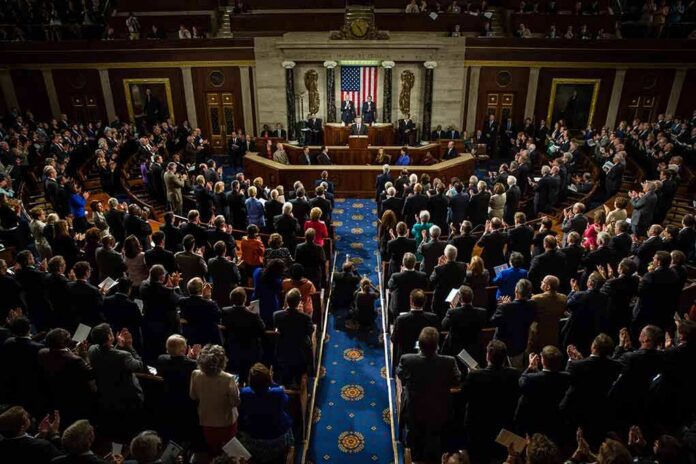
Impeachment and removal are not the same thing; the Constitution makes the House’s power to impeach attainable by a simple majority, while it makes removal by the Senate deliberately hard—requiring two-thirds of senators present—so partisan control of the House can trigger impeachment, but it rarely translates into removal.
At a Glance
- The House can impeach a president with a simple majority; the Senate can convict only with two-thirds of members present.
- These are separate proceedings: a House majority may impeach even when the Senate math for removal does not exist.
- Historically, presidents are impeached more readily than they are convicted; no president has been removed by Senate judgment.
- Trump’s two acquittals illustrate the supermajority brake: significant votes for guilt still fell short of two-thirds.
What it actually takes: the constitutional mechanics
The Constitution places the charging function in the House and the trial function in the Senate. The House “shall have the sole Power of Impeachment,” exercised by a simple majority. If articles are approved, the process moves to the Senate, which “shall have the sole Power to try all Impeachments.” Conviction—and thus removal—requires “the Concurrence of two thirds of the Members present.” This bifurcated design is not a procedural quirk; it is the mechanism by which the Framers ensured that initiating an impeachment is politically reachable, while removal demands a bipartisan supermajority. The Senate’s own official guidance and the Constitution Annotated (Congress’s nonpartisan legal commentary) set out these thresholds plainly.
Practically, that means House control answers the yes-or-no question of impeachment. Senate outcomes turn on a stricter denominator: two-thirds of those present, not merely a majority. When the President is tried, the Chief Justice presides, but that does not alter the two‑thirds rule. The distance between a simple majority and two-thirds is where most modern presidential impeachments stall.
History’s verdict: impeachment is common enough; removal is not
Across two centuries, Congress has impeached a modest number of federal officers and convicted even fewer. The House has impeached 20 officials, including three presidents; the Senate has convicted eight—all judges. No president has ever been removed following Senate conviction. That asymmetry is the constitutional design in action, not a historical accident. It takes cross-party consensus to reach 67 votes in a 100-member Senate, or the applicable two-thirds of those present when attendance varies. Nonpartisan Congressional Research Service (CRS) accounts and the Constitution Annotated document this pattern in detail.
Donald Trump’s record is illustrative. The Senate acquitted him in both trials. In 2020, the articles failed 48–52 and 47–53, respectively—solid vote shares, but far short of two-thirds. In 2021, 57 senators voted to convict on the single article, including seven Republicans—the largest bipartisan vote to convict a president in history—yet still short of the constitutional threshold. These outcomes underscore the supermajority brake: even visible defections and majority support do not suffice without a coalition broad enough to clear two-thirds.
Why the math separates impeachment from removal
The supermajority rule converts removal into a coalition project. In a closely divided chamber, the majority party can originate and drive impeachment in the House with its own votes; it cannot achieve removal in the Senate without substantial support from the minority. That is by design. Hamilton described impeachment as a political remedy safeguarded by political judgment. The two-thirds requirement forces that judgment to be shared across factions, raising the evidentiary and political bar well above ordinary legislation. The result is a structural reality: a motivated House can almost always impeach; a polarized Senate almost never convicts.
Importantly, the Senate’s threshold is keyed to “members present.” That clause can matter at the margins—for example, if illnesses, recusals, or strategic absences reduce the voting pool—but it does not lower the substantive hurdle. Two‑thirds is still two‑thirds. In modern practice, high-stakes trials see near-perfect attendance, keeping the effective target at or near 67 votes.
What impeachment accomplishes when the Senate path is blocked
When removal is improbable, impeachment still has legal and political functions. First, it formalizes allegations as articles, framing a trial record and focusing public and congressional attention. Second, it can strengthen the House’s litigation posture in subpoena disputes; while courts independently assess congressional need and scope, an impeachment inquiry can clarify purpose and urgency. That said, subpoena battles remain subject to judicial review and can take months or years—far slower than political calendars—so impeachment is not a shortcut around the courts. The Constitution and CRS explain these institutional rhythms; they are features of separation of powers, not bugs.
Politically, impeachment can anchor accountability narratives and signal norms. Yet because only the Senate can convict and remove, impeachment that cannot clear two-thirds functions as censure with ceremony. The Trump trials demonstrated both edges: significant majorities favored conviction in 2021, but the constitutional brake delivered acquittal all the same.
Trump’s impeachments as a case study in constitutional friction
Trump’s two Senate acquittals are not anomalies; they track the historical pattern. In 2020, neither article reached even a simple majority for conviction, reflecting strict party alignment. In 2021, the chamber produced a 57–43 vote to convict—substantial, bipartisan, and still insufficient. The lesson is not merely that the bar is high; it is that presidential removal requires a rare political alignment: evidence persuasive enough to move the president’s own party in large numbers, timing that tolerates neither delay nor attrition, and a public climate that rewards defection rather than punishes it. That triad seldom converges, which is why resignations under party collapse (as with Nixon) have proven more likely than Senate convictions.
For readers parsing “Do the Democrats have the seats to impeach?” the answer is straightforward: if they hold a House majority, they have the votes to impeach. The harder question—“Do they have the votes to remove?”—is answered by the Senate’s arithmetic and history: absent a sweeping, bipartisan coalition well beyond simple control of the chamber, they do not.
🧵 2/4
🧮 𝗧𝗛𝗘 𝗠𝗔𝗧𝗛 🧮
A House impeachment passes with a simple majority. Al Jazeera counts 214 Democrats in the current House, so a handful of Republicans would get Massie to 218. [3]
Removal is a different animal. The Constitution requires two-thirds of senators…
— Cooper (@CooperUnbound) November 5, 2026
The enduring takeaway: numbers, thresholds, and outcomes
Impeachment is a majority instrument; removal is a supermajority verdict. That one-sentence summary explains both the frequency of presidential impeachments in a polarized era and the rarity of removals. It also explains why political energy often migrates to the powers Congress can exercise without supermajorities—appropriations, oversight, confirmations—where majorities matter more than thresholds. The Constitution’s architecture ensures that presidents can be accused and tried without being toppled unless a broad swath of the Senate agrees. Across administrations and parties, that constraint, not the passions of the moment, has proven decisive.
Sources:
youtube.com, senate.gov, constitution.congress.gov, congress.gov, cbsnews.com, inquirer.com
© totalconservative.com 2026. All rights reserved.