
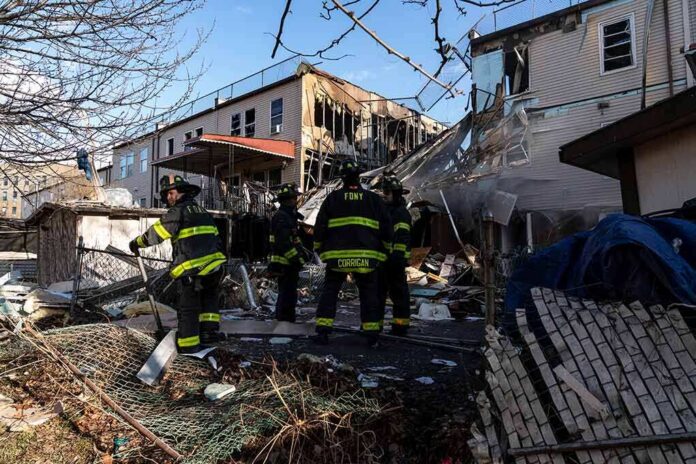
Eight people are dead and more than a dozen are injured after a Brooklyn apartment building collapsed next to an open construction site, triggering a massive rescue operation, officials said.
Story Highlights
- Firefighters launched an active search-and-rescue after the collapse near Flatbush and Bedford.
- Officials reported multiple rescues and hospital transfers during the response.
- The site sat beside an excavation, and investigators are probing what caused the failure.
- Conflicting early counts and shifting addresses reflect a fast-moving emergency scene.
Rescue Operation Launched After Afternoon Collapse
Fire Department of New York (FDNY) units rushed to Flatbush on Wednesday after reports of a collapse just after 4 p.m. near Bedford Avenue and Flatbush Avenue. Firefighters searched the rubble for people believed trapped, while medics treated the injured on scene. Officials reported removing multiple victims from debris and transferring others to nearby hospitals, including Kings County Hospital, as the rescue continued into the evening hours.
New York City Police Department officers, city emergency managers, and building inspectors established a perimeter and shut roads to keep crowds and traffic away from unstable structures. The Office of Emergency Management urged people to avoid the area because of ongoing operations and street closures. Crews used technical tools to shore weak sections and to tunnel into compacted debris. Commanders staged heavy equipment nearby but prioritized hand searches to avoid further collapse risks.
Evidence of an Excavation Next Door Raised Safety Concerns
Reporters on scene and local outlets described a three-story building giving way beside an open construction or excavation site. Photos showed a neighboring wall torn open, exposing apartment interiors and personal items. That damage pattern matched hazards that demand slow, controlled rescue tactics. The New York City Department of Buildings opened an investigation to assess structural forces, site practices, and whether code violations or design issues played a role. Authorities did not announce a cause during the rescue phase.
Conflicting details emerged as responders worked. News outlets cited different street numbers, including 2625 Bedford Avenue and 1321 to 1325 Flatbush Avenue, likely reflecting property lines and corner addresses used by witnesses and dispatchers. Injury counts also shifted as medics re-triaged patients and as rescues continued. Such moving figures are common in major collapses where crews must act before full head counts are confirmed.
What We Know About Victims, Hospitals, and Scene Control
FDNY and police radio traffic pointed to multiple rescues from the structure, with at least two people pulled from rubble early on and additional patients transported to area hospitals. Later updates referenced rising injury totals and at least one death, with some reports listing more than ten injured. Officials emphasized that searches were still underway, and that numbers would firm up only after crews finished their sweeps and reunified residents with families.
🚨 #UPDATE: At least 8 people are dead and 19 others injured, including at least 7 children, following the apartment building collapse in Brooklyn, New York.
The building, located at 1321 Flatbush Ave. in the Flatbush neighborhood, crumbled around 4 p.m. Wednesday.
FDNY and… https://t.co/m19O5nYGhU pic.twitter.com/24xnYF4TsZ
— zach bitango (@ZachBitango) November 12, 2026
City officials asked nearby residents to shelter in place or leave buildings that showed cracks or other signs of stress. Inspectors evaluated adjacent structures for lean, shear cracks, and foundation movement. Where needed, responders installed temporary shoring and barred reentry until engineers cleared the space. The focus stayed on life safety: finding survivors, preventing secondary collapse, and routing stable patients out to relieve pressure on medics at the scene.
Why Collapses Produce Confusing Early Reports
Structural failures often create an information gap. First responders must choose fast rescue methods while engineers work to understand why a building failed. The National Institute of Standards and Technology (NIST) explains that full investigations require debris analysis, design records, video, and interviews, and these steps take time. That means early casualty counts and even addresses can shift while officials build a reliable picture of what happened and why.
New York City’s Department of Buildings maintains construction safety rules, public violation data, and annual reports meant to drive down site incidents citywide. The agency reports that enforcement actions and training have increased in recent years. Even with those gains, a single missed support, a weak wall, or poor excavation control near older structures can trigger failure. The investigation at this site will look at plans, permits, site monitoring, and whether work met the city’s standards.
Shared Questions That Matter After the Rescue
New Yorkers across the political spectrum ask the same core questions after a deadly collapse: who approved the work, who checked the site, and did anyone ignore warnings? Those answers live in inspection records, permit files, and engineering reports that must be made public. Clear, consistent updates from FDNY, police, and building officials can honor victims, steady the community, and show that rules protect people, not just paperwork or powerful interests.
As investigators gather facts, the community needs three things. First, a verified victim count and timeline of rescues. Second, a clear map of the site that reconciles the Flatbush and Bedford addresses. Third, a cause analysis that traces each failure back to a decision, design, or condition. Transparent findings can drive better safeguards on excavation, underpinning, and inspections so families can trust the homes around them are safe.
Sources:
foxnews.com, amny.com, abc7.com, nydailynews.com, nyc.gov, nist.gov, home4.nyc.gov
© totalconservative.com 2026. All rights reserved.