At the Flight 93 National Memorial, white flowers and spoken names mark a precise, public promise to remember every one of the 40 passengers and crew.
Story Snapshot
- The National Park Service permits biodegradable tributes, including flowers, to honor Flight 93’s passengers and crew.
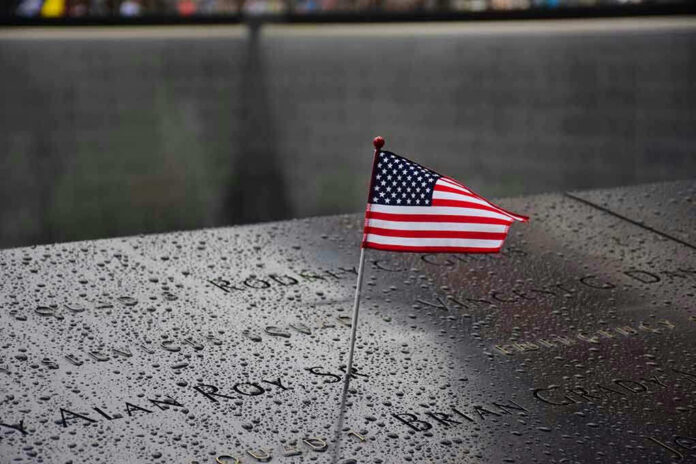
- The Wall of Names lists all 40 people who died aboard Flight 93, each name cut into white marble.
- A formal Moment of Remembrance reads the 40 names and rings bells after each one.
- The crash site is treated as the final resting place of the passengers and crew.
What The Memorial Officially Honors
The National Park Service states the Flight 93 National Memorial exists to honor the 40 passengers and crew who died in Shanksville, Pennsylvania, on September 11, 2001. The agency allows visitors to leave biodegradable tributes, including flowers and wreaths, as part of that public remembrance. Staff remove items after a short period to preserve the site. These rules make floral gestures part of an accepted, respectful practice at the memorial.
The Wall of Names anchors this practice. Forty polished stone panels display the names of each passenger and crew member. The design turns a list into a place where people can stand, reflect, and connect a tribute to a specific person. The marble wall sits along the path that leads toward the crash site. It forms a quiet line of names that the public can see and read, one by one, in a set order.
How Rituals Give Shape To Memory
Each year, the memorial holds a Moment of Remembrance that reads all 40 names aloud. A bell tolls after each name. The program invites the public to witness and take part in this ceremony. It links sound, time, and names so that remembrance is not vague. People hear each person’s name and then the bell’s ring. This structure reflects a simple idea: memory lasts when we repeat it with care.
The Memorial Plaza marks the boundary to the crash site, which the National Park Service treats as the final resting place of the passengers and crew. That status explains why rules around tributes matter. The plaza channels visitors to a set path and spaces for wreaths or flowers while protecting the ground beyond. The design helps people mourn while keeping the resting place itself undisturbed and dignified.
Why White Flowers Resonate Across 9/11 Sites
White flowers appear often at 9/11 memorials. The United States Mint described a single rose on a national medal as an echo of the New York tradition, where staff place a white rose on a victim’s name on his or her birthday. That wider custom helps explain why visitors bring white flowers to Flight 93. It is a simple symbol that signals purity, loss, and respect without words.
One by one, white roses are laid at the Flight 93 National Memorial, each honoring a life lost on 9/11.
About 90 American Airlines and United Airlines flight attendants, joined by United pilots, walk to the wreath-laying area and place a single rose in memory of the 40… pic.twitter.com/6hsIdnJENi
— Fox News (@FoxNews) September 11, 2026
The National Park Service also lists every passenger and crew member by name on its site, including the pilots and flight attendants. Families and visitors can link a flower, a note, or a prayer to a specific person. That human scale matters in a time when mass tragedy can feel abstract. The memorial’s design, the reading of names, and permitted tributes work together to keep the focus on individual lives, not only on a date or an event.
What This Says About Us Now
Americans across politics worry the system forgets everyday people. The Flight 93 memorial offers the opposite model. Officials set clear rules, protect sacred ground, and make space for the public to honor real names. The ceremonies are plain and public. They do not ask for a party label. They ask for attention, respect, and truth. In a noisy era, that is a rare civic act that still works because it is specific, open, and human.
Sources:
facebook.com, nps.gov, en.wikipedia.org, home.nps.gov
© totalconservative.com 2026. All rights reserved.