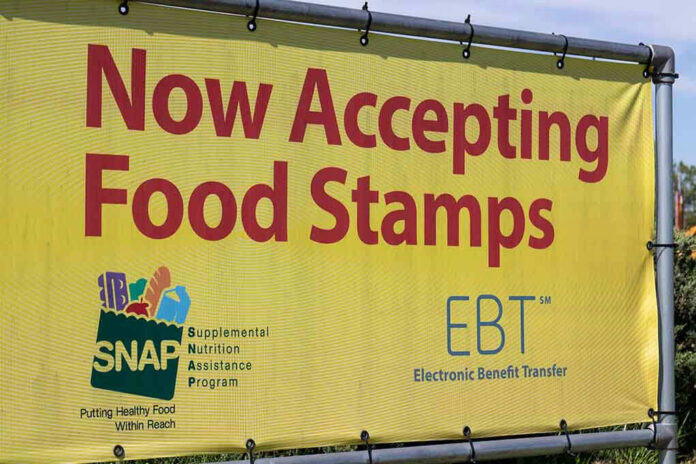
Millionaires are legally collecting food stamps through a federal loophole that has persisted for over a decade despite clear evidence of abuse and bipartisan calls for reform.
Quick Take
- A structural vulnerability in SNAP allows 43 states to nullify federal asset limits, enabling an estimated 4-5 million individuals with substantial wealth to receive food assistance
- Documented cases include lottery winners with millions in assets and early retirees continuing to collect benefits while sitting on six-figure bank accounts
- The Broad-Based Categorical Eligibility (BBCE) loophole costs taxpayers an estimated $10-112 billion over ten years and undermines the program’s core mission
- 73 percent of likely voters support asset checks for applicants, yet Congress has failed to close the loophole despite a decade of warnings from federal watchdogs
- Trump administration officials have committed to regulatory action, but systemic reform requires congressional intervention
How Millionaires Exploit Federal Food Assistance
The SNAP loophole operates through a policy mechanism called Broad-Based Categorical Eligibility, which allows states to extend food stamp benefits to households that qualify for other welfare programs regardless of actual financial resources. Federal regulations permit states to set income thresholds up to 200 percent of the poverty line and, critically, to eliminate asset tests entirely. Forty-three states and Washington D.C. have adopted BBCE, with 28 setting income limits at the maximum threshold and all but five states abolishing asset checks completely.
Real Cases Expose the Absurdity
The loophole isn’t theoretical—it’s actively enriching the wealthy at taxpayer expense. A Minnesota early retiree with millions in assets received over $6,000 in SNAP benefits across 19 months. A Michigan lottery winner who collected $2 million in 2011 continued receiving food stamps. A 25-year-old Michigan woman who won a $1 million jackpot maintained SNAP eligibility. While extreme cases, they reveal a systemic problem affecting millions of households with significant countable assets. Among individuals with assets above federal limits, more than one-third hold $50,000 or more, and one-fifth possess $100,000 or more.
Federal Watchdogs Sound the Alarm
The Government Accountability Office, the federal government’s independent watchdog, identified concerns with BBCE approximately 12 years before 2025, warning that the policy undermines program integrity. Representatives from both parties have expressed outrage. Representative Dusty Johnson of South Dakota, a sitting member of the House Agriculture Committee, called BBCE “an embarrassment.” Representative Ben Cline of Virginia introduced the “No Welfare for the Wealthy Act” to eliminate the loophole and require states to enforce federal asset and income limits. Yet despite a decade of bipartisan concern, the loophole persists.
Staggering Fiscal Impact
The Foundation for Government Accountability estimates that 5.4 million SNAP recipients exceed either federal income or asset limits as of 2023. Closing the loophole could save between $10 billion and $112 billion over ten years, depending on implementation approach. These aren’t marginal savings—they represent resources that should be directed toward genuinely disadvantaged Americans. The program itself has exploded from 17.1 million recipients in 2000 costing $17 billion annually to 41.1 million recipients in 2022 costing $119 billion. Much of this expansion occurred through BBCE adoption, which increased enrollment beyond the program’s original targeting parameters.
What Voters Actually Want
Public opinion overwhelmingly supports reform. A 2023 poll found that 73 percent of likely voters supported checking prospective SNAP recipients’ financial assets to ensure they are truly eligible. This reflects common-sense conservative values: safety net programs should assist those genuinely in need, not subsidize the wealthy. The disconnect between voter preferences and government action illustrates how bureaucratic inertia and federal-state coordination problems allow absurd policies to persist despite clear public opposition and documented harm.
Trump Administration Signals Action
USDA Secretary Brooke Rollins has committed to taking meaningful action to enforce SNAP’s eligibility standards through regulation, specifically by tightening BBCE requirements. The House Agriculture Committee has proposed changes including restricting eligibility to U.S. citizens and green card holders and narrowing work requirement waivers. However, systemic reform requires congressional legislation, and as of December 2025, no comprehensive bill has definitively closed the loophole despite multiple proposals under consideration. The persistence of this scandal reflects how federal-state welfare coordination problems allow states to expand programs while shifting costs to federal taxpayers.
Sources:
SNAP Loophole Lets Millionaires Receive Food Stamps – Cato Institute
Can Millionaires Really Receive Food Stamps? – EPIC for America
New Bill Could End Loophole That Gives Food Stamps to Millionaires – Solutions Project