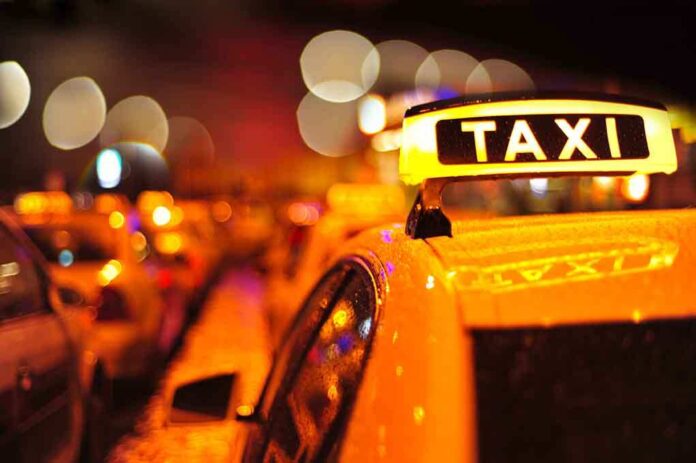
A San Francisco woman just delivered her baby inside a driverless Waymo taxi that was quietly watching, listening, and calling 911—raising big questions about where lifesaving tech ends and always‑on surveillance begins.
Story Snapshot
- A woman gave birth in a fully driverless Waymo taxi on the way to UCSF Medical Center in San Francisco.
- Waymo’s remote team detected “unusual activity,” called the rider, and then alerted 911 while the car drove on autopilot.
- The incident is being used to polish Big Tech’s image after recent traffic violations and a viral pet death involving Waymo.
- Behind the heartwarming spin are serious concerns about constant in‑car cameras, data collection, and accountability.
A birth story Silicon Valley is eager to turn into a PR win
Media outlets are celebrating a feel‑good story out of San Francisco, where a pregnant woman called a Waymo robotaxi for a ride to UCSF Medical Center and ended up delivering her baby in the back seat before reaching the hospital. The driverless car kept moving through city streets on its own while the woman gave birth. Waymo later announced the incident, emphasizing that both mother and baby arrived safely and were admitted by hospital staff.
Waymo’s own description of events highlights that this was not some fringe test but a commercial ride in a city that has become a proving ground for autonomous vehicles. The ride took place on a Monday in early December, and by midweek the story had gone out on the Associated Press wire and into local and national outlets. The company quickly framed the episode as proof that its technology can be trusted during “big and small” life moments, from everyday errands to childbirth.
How the robotaxi knew something was wrong inside the car
According to the company, a remote rider support team noticed “unusual activity” inside the driverless taxi during the trip. Staff then called the rider to check on her and contacted 911 when it became clear she was in active labor. The car continued along its preplanned route to UCSF and reportedly reached the hospital before emergency services could arrive, where medical staff took over care for the mother and newborn.
Waymo has previously acknowledged that its vehicles carry cameras and microphones inside and outside the cabin. Those systems, combined with software that flags unexpected motion, noise, or behavior, almost certainly enabled the company to see that something serious was happening in real time. Yet Waymo declined to say exactly how its system detected the emergency, keeping the public in the dark about what is being recorded, how long it is stored, and who can access it.
Good optics for Big Tech after dangerous missteps on city streets
This feel‑good narrative comes after a string of incidents that put Waymo and the broader autonomous‑vehicle experiment under harsh scrutiny. In September, one of the company’s driverless cars made an illegal U‑turn in San Bruno directly in front of a posted “No U‑turn” sign. Local police said state law left them unable to issue a ticket because there was no human driver, exposing a clear accountability gap when machines break the rules on public roads.
Just weeks later, another Waymo vehicle in San Francisco’s Mission District ran over and killed a well‑known neighborhood tabby cat nicknamed Kit Kat. Residents described the animal as a beloved “bodega cat,” and the death sparked anger both on the street and online. Critics saw it as one more sign that unaccountable, corporate‑run robotaxis are being tested on ordinary families and communities without their meaningful consent, while local officials struggle to keep up.
Safety, surveillance, and who really controls the road
The birth in the robotaxi will be cited by Waymo and other tech giants as proof that constant monitoring can save lives and justify rapid expansion of driverless fleets. There is no question that swift detection and a 911 call helped this mother reach the hospital. But those same always‑on cameras and microphones raise serious questions for privacy‑minded Americans about where all that intimate data goes and how it might be used by corporations or government down the line.
For conservatives who value limited government, personal responsibility, and local control, this episode is about far more than a dramatic birth. It sits at the intersection of Big Tech influence, regulatory loopholes, and public safety. When a machine can break traffic laws without a ticket, record everything inside your car, and still be celebrated as a hero, it is a reminder that technology policy must keep individual liberty and accountability front and center—not corporate narratives crafted after the fact.
Sources:
Woman Has Baby in Waymo Self-Driving Taxi in San Francisco
San Francisco woman gives birth in a Waymo self-driving taxi