
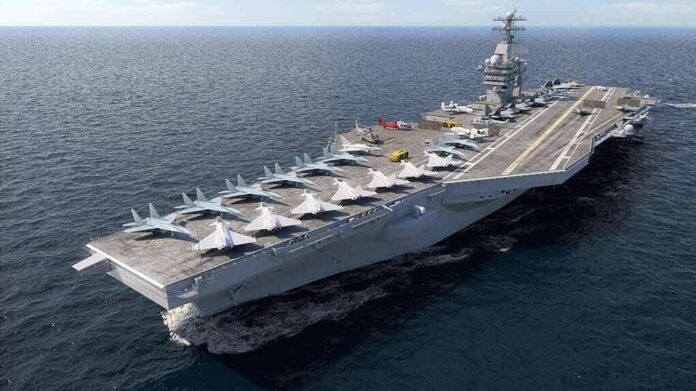
President Trump ordered the Navy to scrap electromagnetic launch gear on the next Ford-class carrier and return to proven steam catapults to speed reliability and readiness.
Story Snapshot
- White House directive tells the Pentagon to use steam and hydraulic systems on CVN-81.
- Design switch aims to boost launch reliability after years of carrier delays.
- Plan pairs a return to steam with steps to expand shipbuilding capacity at home.
- Policy also permits up to two Navy ships to be built overseas under strict limits.
What The Order Does And Which Ship It Hits
White House guidance requires the Department of Defense to replace the Electromagnetic Aircraft Launch System on the next Ford-class carrier, designated CVN-81, with steam catapults and related hydraulic gear. Reporting says the change targets the ship now in design, not those already delivered or under heavy construction. The goal is simple: field a dependable launch system that sailors know well and that shipyards can install with fewer surprises.
The directive follows years of problems tying new technology to tight carrier schedules. The electromagnetic launcher promised faster cycles and gentler aircraft launches. The system also brought software and power hiccups that slowed testing and raised costs. By choosing steam, the administration signals that getting flight decks fully mission ready now outweighs chasing incremental gains from complex, still-maturing gear on this hull.
Why Return To Steam: Reliability First
Carrier air wings must launch on time, in all seas, every day. Steam catapults have done that for generations with parts, manuals, and know-how across the fleet. Leaders backing the change argue the Navy cannot afford more years of carrier debug cycles when threats are growing. They point to practical risk: one balky launcher can idle combat power for hours. A proven system reduces that risk and lets crews focus on flying, not babysitting electronics.
Critics warn the redesign could add costs. Reuters reports hundreds of millions of dollars are possible. Supporters counter that predictable technology can save money by limiting yard delays, rework, and test slippage. In warship building, time is cash. A one-year delay on a nuclear carrier ties up thousands of workers and pier space. The administration frames steam as a trade that buys schedule certainty and combat uptime now, at a known engineering risk.
Building Capacity: More Yards, Tighter Timelines
The carrier change lands alongside a broader push to rebuild maritime power. President Trump’s executive order on “Restoring America’s Maritime Dominance” directs a full Maritime Action Plan to grow shipyard capacity, workforce, and tooling. The strategy blends direct investment, tax support, and tighter program management to break logjams that have plagued Navy production and repair backlogs. The aim is more ships delivered, faster, with less downtime for critical platforms.
The White House plan also opens a narrow lane for foreign-built Navy ships. A signed memorandum permits up to two vessels to be constructed in a parent shipyard overseas, under set conditions, to kick-start throughput while American yards scale up. Supporters sell this as a pressure valve, not a handoff of the fleet. Two hulls can relieve timelines now, while new facilities and workers come online at home to carry the long fight against peer navies.
Strategic Stakes: Delivering Combat Power Without Excuses
China and other rivals are launching ships at a blistering pace. U.S. carriers, destroyers, and submarines must be ready and present. The administration’s pairing of a back-to-basics carrier launcher with an all-of-the-above industrial plan reflects a battlefield truth: combat credibility comes from what sails today. A carrier that flies every cycle is a stronger signal than another year of trials. Steam catapults help ensure that signal is loud and constant.
🌅 Market News Digest
Aug 13-14, 2026 EST🔥 Top Stories
• US affirms AA+ with stable outlook — Fitch sees resilient growth, but warns on deficits, debt ceiling risk and rising fiscal pressures
• Trump hits drones with tariffs + orders Navy carrier tech rollback — 100% levy on…— MarketNewsFeed (@MarketNews_Feed) August 14, 2026
This approach will face engineering and budget hurdles. Switching launch systems mid-design is not simple. But the policy sets a clear test: reduce risk, hit dates, and keep the air wing in the fight. If the Navy and industry align training, parts, and yard work to this plan, the fleet can claw back time lost to delays. The message to adversaries is direct: America will field reliable decks, grow ship output, and meet the moment with hard steel and dependable gear.
Sources:
theguardian.com, reuters.com, whitehouse.gov
© totalconservative.com 2026. All rights reserved.