Federal reviewers advanced President Trump’s 250-foot Triumphal Arch while critics claim it lacks clear military backing and could harm landmark views.
Story Highlights
- National Capital Planning Commission gave preliminary site and building approval.
- Planning records show work hours, mitigation steps, and a build pathway.
- President Trump said the arch would double as a “top grade Military Complex.”
- Opponents argue it needs new congressional approval and harms key sightlines.
Federal Reviews Move The Project Forward
The National Capital Planning Commission granted preliminary approval for the Triumphal Arch at Memorial Circle. The vote cleared site and building plans, keeping the project on track while final reviews continue. The Interior Department and the National Park Service advanced the effort through planning files and a Section 106 historic review process. Those records include a draft memorandum of agreement that treats impacts and lays out mitigation steps rather than stopping the project outright.
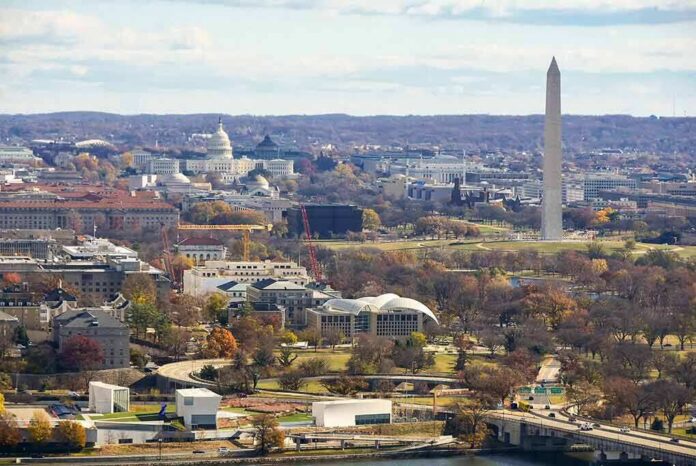
National Park Service materials describe a 250-foot monument sited near Arlington Memorial Bridge. The documents explain how the location fits a ceremonial gateway and the “Avenue of Heroes” theme along the parkway. The administration also filed renderings and design presentations with federal design bodies in April 2026. President Trump highlighted that filing and called the design “the greatest and most beautiful Triumphal Arch,” signaling formal submission to the Commission of Fine Arts.
Schedule, Construction Plan, And Mitigation Steps
Planning reports describe an aggressive build window. They say excavation could start fast and crews could work up to 20 hours per day in long shifts. Those materials estimate construction could take two to three years once underway. The National Park Service circulated a mitigation framework that includes vibration monitoring, an archaeological work plan, and steps to protect ceremonial routes and explain impacts to the public through interpretive pages online. That structure shows the agencies are managing effects rather than rejecting the project.
Funding lines identified by the administration include special initiative dollars and matching grants. Reports state the plan sets aside $2 million in initiative funds and $13 million in matching grants for the arch. Those figures point to an intention to blend public sources and outside dollars to carry the design forward. While that planning helps timelines, critics still question whether separate authorization is needed for full build-out at that scale and in that location.
Military-Complex Claim Meets A Thin Public Record
President Trump said the arch will also serve as a “top grade Military Complex,” and he linked that role to national security and a request from the United States military. Reports added striking examples like sniper positions and drone use tied to the complex label. However, the gathered public planning record so far describes a monument and mitigation plan. It does not include a named military sponsor, force-protection plan, or engineering proof of security-specific features in open files.
Because the public documents emphasize commemoration, design, and preservation review, the “military complex” framing faces a credibility test unless the administration releases defense-side records. A clear statement from the Department of Defense, the Army, or the Pentagon facilities office would answer that gap. Until then, the strongest on-record facts are the monument’s approvals, the mitigation plan, and the stated ceremonial goals for the site.
Opposition Focuses On Sightlines, Process, And Authority
Opponents, including Vietnam War veterans and an architectural historian, argue the project lacks new congressional authorization and would harm sacred views. They cite the symbolic line from Arlington House and Arlington National Cemetery to the Lincoln Memorial, and warn the structure would block or alter those views. They also argue that the site’s scale and height could loom over parts of the cemetery and nearby memorial spaces.
Live updates: Trump adds snipers to DC triumphal arch plans; tensions run high in Middle Easthttps://t.co/XzKMQlmaDs
— Todd🏳️🌈 (@Phoenix_Onyx89) September 20, 2026
Preservation reporting says the National Park Service found “adverse effects” to dozens of historic sites and views, including the Lincoln Memorial and Arlington National Cemetery. The agency also drafted mitigation steps and still set the project to proceed, which keeps the process moving but raises more debate. Veterans and relatives call the plan a vanity project that disrespects hallowed ground; supporters say it honors valor and American heritage near a key ceremonial route.
What To Watch Next
Two questions now drive the policy stakes. First, will the administration publish a formal defense mission for the site, with a named military customer and security design elements? That would support the “military complex” claim and help justify unique measures if needed. Second, will a court or Congress weigh in on authorization or limits at Memorial Circle? Until those answers arrive, preliminary approvals, mitigation planning, and excavation timelines remain the live facts on the ground.
Sources:
theguardian.com, yahoo.com, cnbc.com, spectrumlocalnews.com, washingtonian.com, upi.com, politico.com, cnn.com, npr.org, wtop.com
© totalconservative.com 2026. All rights reserved.