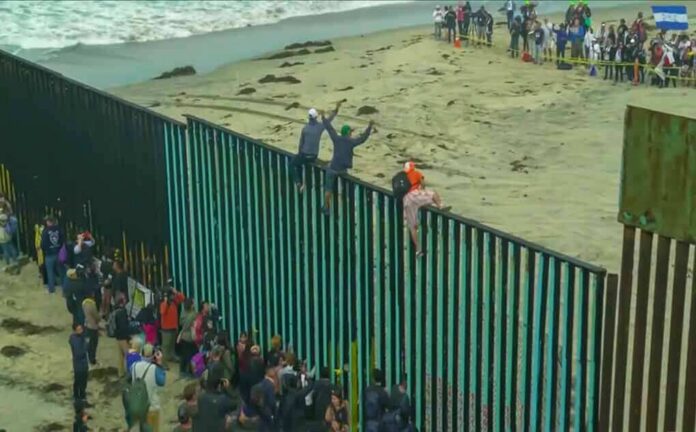
As up to 60,000 people surged into Spain’s tiny enclave of Ceuta from Morocco, at least 41 migrants died and Spain’s pro‑immigration government rushed to deny direct blame even as its border system buckled under the strain.
Story Snapshot
- About **40,000–60,000 migrants** entered Ceuta from Morocco in roughly 24 hours, overwhelming local services.
- At least **41–43 people died** by drowning or stampede during chaotic crossings at the Tarajal border and nearby beaches.
- Ceuta’s leader declared an “absolute humanitarian and social emergency” and begged Madrid for troops and stronger control.
- Prime Minister Pedro Sánchez blamed **trafficking gangs**, while critics pointed to court rulings and long‑running border failures.
How the Ceuta border crisis exploded in hours
Local and national officials say the Ceuta crisis unfolded with stunning speed. Between Thursday and Friday, somewhere between **40,000 and 60,000 people** crossed from Morocco into the six‑mile‑long Spanish territory, many by swimming around sea barriers or climbing border fences. Ceuta’s regional president Juan Jesús Vivas said the situation was “absolutely unsustainable” for a city of only about 83,000 residents and urged Madrid to send troops and reassert control at the frontier. Spain’s Interior Ministry gave a lower crossing figure but confirmed that tens of thousands entered and that more than 25,000 later walked back through a border‑gate door into Morocco.
The human cost rose quickly as people tried to reach what they hoped was the edge of Europe. Officials and aid workers reported that many migrants **drowned in strong currents**, while others died in stampedes as crowds rushed the breakwater fence at Tarajal beach near a border checkpoint. Spain’s government spokesman first confirmed at least 18 dead, but local and national counts later rose, with some reports citing **34 to at least 41–43 deaths** linked to these crossings. Many victims remain unidentified, echoing past tragedies along this same stretch of coast, where earlier crossings had already killed dozens over the last year.
Madrid’s response and the fight over who is to blame
As the scale of the crossing became clear, Spain deployed military personnel to Ceuta to back up the Civil Guard and support emergency shelters and medical care. Prime Minister Pedro Sánchez flew to the enclave and condemned the surge as “a violation of Spain’s territorial integrity,” while insisting the main culprits were **human‑smuggling gangs** that misled vulnerable people with false stories about new Spanish migration rules. His Interior Ministry initially refused to confirm the full crossing figures, then later released its own lower estimate and stressed that **25,000 to 37,500 people had voluntarily returned** to Morocco after realizing they had no clear path onward into the European Union.
Ceuta authorities, however, tied the mass attempt in part to a **recent Spanish Supreme Court ruling** that barred immediate returns for migrants who arrive by sea without due process. They argue that this legal change weakened deterrence and signaled softer treatment, making risky swims more attractive to desperate people. National officials have not publicly engaged that claim in detail, leaving a gap between Madrid’s focus on traffickers and local fears that the central government’s own pro‑immigration stance and court‑driven limits on “hot returns” helped set the stage for the disaster. This clash feeds a wider view, common on both left and right, that legal elites and distant bureaucrats make rules without facing the real‑world fallout at strained borders.
Morocco’s role and a pattern of recurring border shocks
Reports from Spanish police and regional media show that events on the **Moroccan side of the border** heavily shaped the outcome. Crowds gathered near Fnideq and other coastal areas, and many people entered the water using inflatable gear or simple flippers, while Moroccan security forces tried to push others back using tear gas, water cannons, and warning shots. Spanish sources also say Moroccan officers stopped many migrants from continuing, underscoring that what happens in Ceuta depends on decisions in Rabat as well as Madrid. This mirrors a 2021 incident when Moroccan forces relaxed controls and about 8,000 people reached Ceuta in two days, triggering another humanitarian emergency Spain struggled to manage.
Spain stepped up its response to a deepening migrant crisis in its North African enclave of Ceuta, deploying armed forces to support the Civil Guard after thousands of migrants crossed from Morocco. By contrast, at least 34 migrants died while attempting to reach Spanish… pic.twitter.com/J9z00HeKOY
— teleSUR English (@telesurenglish) July 31, 2026
The Ceuta tragedy fits a broader pattern that should worry anyone who thinks government is failing ordinary people. On one side, migrants risk death because wars, poverty, and false promises leave them feeling they have no safe options. On the other side, border cities like Ceuta are overwhelmed, while national leaders argue over legal details and blame foreign actors or traffickers. Spanish authorities highlight humanitarian aid and rapid deployments, yet deaths keep mounting year after year, suggesting that deeper structural problems remain untouched. For both conservatives angry about weak borders and liberals alarmed by preventable deaths, the message is similar: complex migration pressures are colliding with slow, opaque institutions, and ordinary lives are paying the price.
Sources:
aljazeera.com, theolivepress.es, euronews.com, youtube.com, facebook.com, news.cgtn.com, en.walaw.press, en.wikipedia.org, thehill.com
© totalconservative.com 2026. All rights reserved.