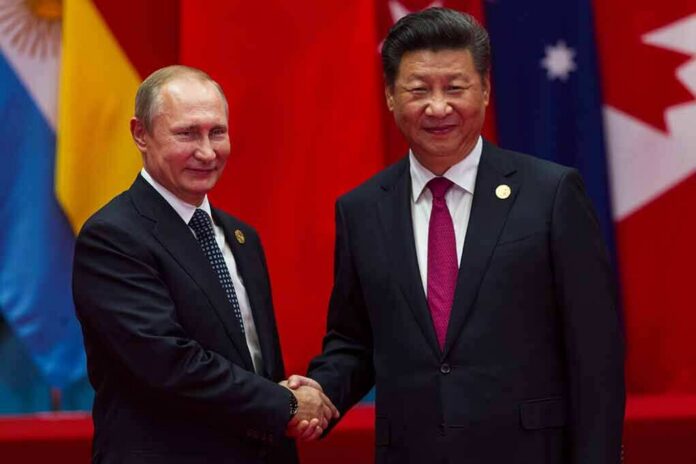
China confirmed that President Trump, President Xi, and President Putin will hold a first-ever three-way summit in Shenzhen on November 19, signaling high-stakes talks on nuclear risks and global security.
Story Highlights
- Beijing announced a trilateral summit with Trump, Xi, and Putin in Shenzhen on November 19.
- China said the talks aim to safeguard world peace and promote strategic stability.
- The White House and the Kremlin also confirmed plans for the meeting.
- Reporting ties the summit to the Asia-Pacific forum schedule in Shenzhen.
Beijing Sets Time, Place, and Purpose
China’s Foreign Ministry said the three leaders will meet in Shenzhen on November 19, calling it a China-Russia-United States heads-of-state meeting. The government framed the talks around world peace and major-power stability. The announcement used standard diplomatic language and did not list deliverables or a joint text. The format places China as host and organizer during the Asia-Pacific forum week, which boosts its status even if outcomes remain open-ended.
Foreign Ministry spokesperson Mao Ning said the leaders will hold in-depth exchanges on safeguarding world peace and promoting strategic stability in relations among major powers. That framing implies discussion of nuclear risks, crisis hotlines, and restraint, without promising a treaty. The language matches how governments often preview leader talks to keep room to negotiate. Media summaries repeated China’s peace message while noting the lack of specific items in the public brief.
Washington and Moscow Confirm Participation
The White House signaled United States participation and identified nuclear issues as a priority. Russian officials and Chinese authorities later confirmed the plan, aligning the three capitals on the basic facts of timing and attendance. That cross-check matters because summit announcements sometimes reflect only one side’s spin. Here, multiple governments described the same event, which supports the record that an unprecedented trilateral is set for Thursday in Shenzhen.
News coverage described the meeting as the first time these three leaders will sit down together in a trilateral format. Analysts highlighted the scale of the nuclear arsenals involved and the chance to manage tensions. Reports also said the broader agenda could touch on international security and regional flashpoints. That mix shows how each side may stress different priorities, even while agreeing to talk at the same table during the Asia-Pacific forum.
Why This Summit Matters at Home and Abroad
The three countries hold the largest nuclear stockpiles. Any step that reduces the risk of miscalculation can affect everyday life, energy prices, and global markets. Past summits have eased tensions even without a signed deal. The United States signaled interest in nuclear non-proliferation and the Middle East war. China emphasized peace and stability. Those messages overlap on risk reduction, which is often the first practical step in talks like this.
Chinese President Xi Jinping and First Lady Peng Liyuan pose for family photos with US President Donald Trump, Russian President Vladimir Putin and other Asia-Pacific leaders at the APEC summit in Shenzhen. pic.twitter.com/Yjl60IDGoK
— Al Arabiya English (@AlArabiya_Eng) November 18, 2026
American readers across the spectrum worry that politicians perform for cameras while problems grow. A short leader meeting will not fix high prices, border strain, or wars. But clear, firm lines between the top powers can lower the odds of a wider crisis that would raise costs at home. If the leaders set a path for expert talks or new hotlines, that could be a concrete win. If they do not, this may still clarify where each side will and will not bend.
What To Watch Next
Watch for official readouts from all three governments in the hours after the meeting. Look for signs of a follow-up schedule, a working group on nuclear risk, or a pledge to keep talking. Compare the language across the White House, the Kremlin, and Beijing to see if they agree on the same goals. If the readouts diverge, expect slower progress. If they align on next steps, expect staff-level talks to test whether leaders’ promises can turn into policy.
Sources:
insiderpaper.com, efe.com, cnbc.com, nbcnews.com, economictimes.com, france24.com, japantimes.co.jp
© totalconservative.com 2026. All rights reserved.