Russian pro-government reports claim a closed-door decision cleared the way to target Ukraine’s president, but no official proof has surfaced to back it up.
Story Snapshot
- Pro-Kremlin outlets report a lifted “ban” on killing Ukraine’s leaders, citing a secret security meeting.
- No Kremlin order, transcript, or named official confirms the claim.
- Reports link the alleged shift to Ukrainian strikes on Russian energy sites, including Ust-Luga.
- Multiple outlets label the reports unverified and based on unnamed sources.
What the reports say about a policy shift
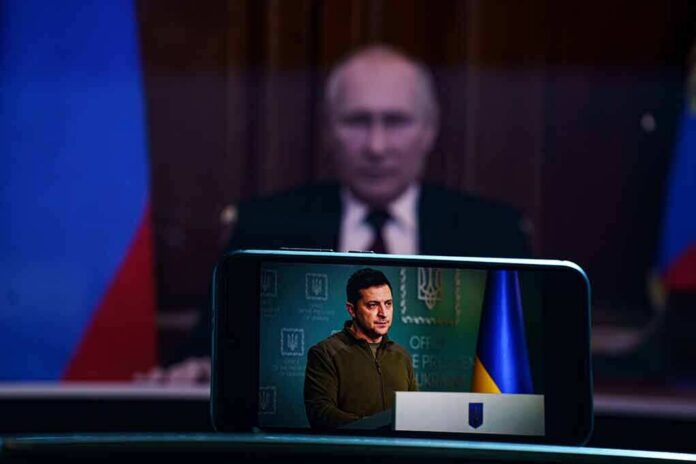
Russian and pro-government media claim Russia’s Security Council met behind closed doors and lifted an informal bar on killing President Volodymyr Zelensky and senior Ukrainian leaders. The reports say security chiefs pushed for this change, and that President Vladimir Putin presided over the session. The allegation echoes across several secondary outlets, which summarize the same core claim without naming sources or providing documents. The stories describe a change in policy but do not present an order, transcript, or on-record quote.
Outlets tie the alleged decision to recent Ukrainian attacks on Russian infrastructure. They highlight strikes against energy targets, including the Ust-Luga oil export port, as the spark for a tougher Russian stance. These links appear in summaries that attribute the cause to anger over damage and risk to key facilities. However, the coverage gives no minutes from the reported meeting and no timeline that proves a direct cause-and-effect decision sequence.
What is missing and why that matters
Independent confirmation is absent. No Kremlin decree, formal directive, or official readout verifies the claim. Several reports stress that the information relies on unnamed sources and pro-Kremlin media channels. One outlet notes that independent Russian journalists traced the story to anonymous social media posts, not to named officials. Without documents, names, or a public statement, the claim remains an unverified intelligence-style report rather than established fact.
The alleged prior “ban” is also undefined. Reports do not show when it began, who imposed it, or what it covered. There is no cited rule text, scope, or enforcement record. That gap matters because it makes it hard to judge whether any real policy changed. If there was no clear, documented restraint, then “lifting” it could be more narrative than law or command. Secondary coverage flags this lack of verifiable background as a key weakness.
How this fits the broader information war
Analysts widely describe Russia’s use of information operations in wartime. These operations push messages that shape fear and pressure, blur facts, and divide audiences. They often aim to unsettle leaders and their allies while boosting domestic resolve. That context makes dramatic, anonymous claims about leadership threats harder to assess. Repetition across outlets can sound like confirmation when it may be only amplification of the same unverified item.
Another reported threat against Zelensky, but where’s the evidence Putin authorised it? If true, it exposes Moscow’s contempt for diplomacy. Meanwhile, Russian generals have been assassinated in Moscow. Perhaps Putin should worry about security closer to home.
— P (@whatwasmeant) November 15, 2026
Ukraine’s leadership has faced threats since the invasion began, and Russia has the means to conduct such attacks. But the leap from capability to confirmed policy needs evidence that is not present here. Without named sources, documentation, or a public directive, the report should be treated as unconfirmed. Several outlets underline this point, noting no independent proof of a new authorization and no evidence that a formal earlier ban existed either.
Why this resonates with Americans across the spectrum
Americans see a pattern: secretive decisions abroad, opaque sources, and information that seems designed to nudge opinion. People on the right and the left are tired of elites and closed-door power. They want clear facts, not spin. This story touches those nerves. It dangles a major shift, hints at payback for energy strikes, and then offers no records. Readers are right to demand proof, given the risks of escalation and the human costs at stake.
What to watch next
Look for hard evidence. A Kremlin readout, a named official, or a leaked directive would move this from rumor to fact. Watch for changes in Russian targeting behavior that match the claim, such as attempts on named Ukrainian leaders. Track intelligence briefings from Ukraine and Western partners for assessments that cite sources and dates. Until then, treat the reports as unverified and shaped by wartime messaging pressures rather than as confirmed policy.
Sources:
x.com, ground.news, ghanamma.com, hamerintel.com, link.springer.com, atlanticcouncil.org, cbc.ca, researchcentre.army.gov.au, economictimes.com
© totalconservative.com 2026. All rights reserved.