
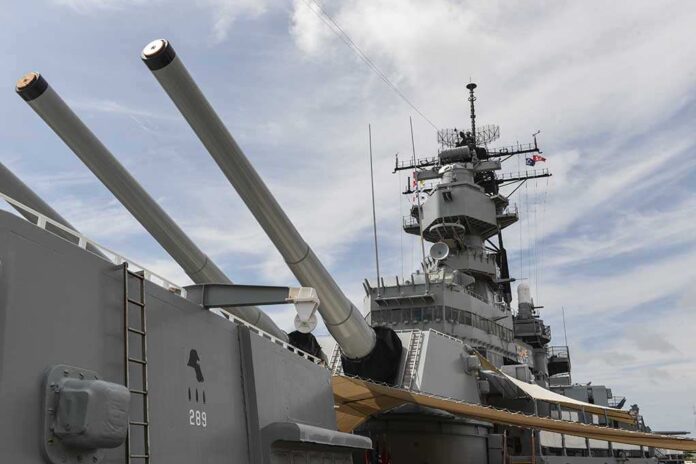
Trump’s Navy eyes massive “Golden Fleet” warships that could bring battleship-style firepower back to American waters, sparking fierce debate over whether these $6 billion floating fortresses represent smart defense or dangerous overreach.
Story Highlights
- Navy developing 15,000-20,000 ton “Golden Fleet” warships with hypersonic missiles
- Each ship could cost $4-6 billion, approaching carrier-level expenses
- Traditional battleships remain obsolete, but missile-armed giants may fill similar role
- Congress demands proof these aren’t “vanity projects” amid shipbuilding failures
Golden Fleet Concept Emerges Under Trump Administration
Senior White House and Navy officials are developing a “Golden Fleet” vision featuring massive warships weighing 15,000-20,000 tons, equipped with hypersonic missiles, integrated electric propulsion, and advanced sensors. These ships would dwarf current destroyers while serving as heavily armed capital ships in a distributed fleet architecture. The concept pairs these giants with smaller corvettes and unmanned vessels, creating a multi-layered force structure designed to counter China’s growing naval power.
The Trump administration’s push for these “battleship-like” vessels represents a dramatic shift from traditional post-WWII naval thinking. Unlike classic battleships with massive guns and thick armor, these modern variants would rely on missile firepower and electronic warfare systems. Defense analysts note that only a handful of American shipyards possess the capacity to build such enormous warships, creating potential bottlenecks in construction timelines.
Classic Battleships Face Insurmountable Modern Obstacles
Traditional battleships like the Iowa-class remain permanently obsolete due to fundamental changes in naval warfare since WWII. Anti-ship missiles, submarines, and aircraft carriers proved that heavily armored gun ships cannot survive modern combat environments. These vessels require massive crews and specialized maintenance while delivering less firepower per dollar than missile-armed destroyers and submarines equipped with precision weapons.
Modern naval strategy emphasizes distributed lethality over concentrated firepower, making traditional battleships tactical liabilities rather than assets. The Navy’s brief 1980s reactivation of Iowa-class ships for Tomahawk strikes and shore bombardment ultimately proved too expensive and manpower-intensive. Today’s precision-guided missiles and hypersonic weapons render thick armor meaningless while demanding electronic warfare capabilities and sensor integration that classic battleships cannot accommodate.
Congressional Skepticism Threatens Golden Fleet Funding
House Armed Services Committee staffers demand proof that Golden Fleet ships aren’t “vanity projects” and can actually survive in hypersonic-rich combat environments. Recent Navy shipbuilding disasters, including the cancelled Constellation-class frigate program and troubled Zumwalt-class destroyers, have made Congress extremely wary of expensive new ship classes. Lawmakers worry about repeating costly mistakes while the industrial base already struggles with labor shortages and supply-chain bottlenecks.
The $4-6 billion per-ship price tag would strain an already tight shipbuilding budget while competing with submarines, carriers, and smaller combatants for funding. Congressional oversight will likely focus on cost-effectiveness and survivability studies before approving any formal program of record. The Navy must demonstrate that these massive ships provide superior lethality and can close kill chains faster than current platforms to justify their enormous expense and resource requirements.
Sources:
U.S. Navy Eyes Next-Generation Golden Fleet Warships to Rival China’s Growing Maritime Strength
What It Would Take to Build Trump’s Golden Fleet Battleships
Could Battleships Really Make a Comeback?
After the Constellation Class: Lessons of the Navy’s Latest Shipbuilding Debacle
The U.S. Navy’s Fiscal Year 2025 Shipbuilding Plan
Navy Cancels Constellation-Class Frigate Program, Considering New Small Surface Combatants