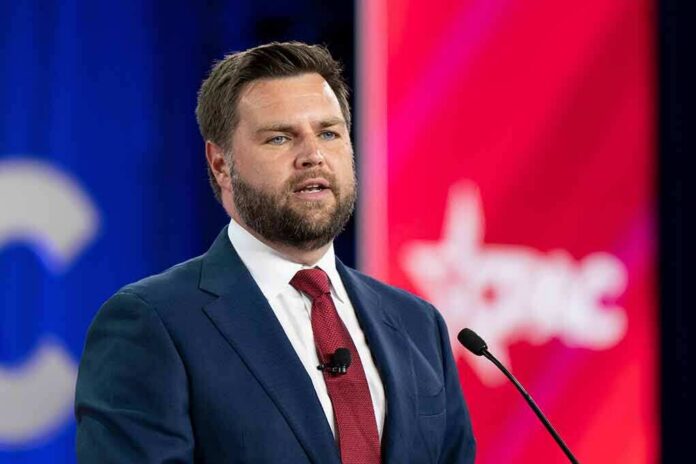
A fight is brewing on the right over Trump’s Iran memorandum, and JD Vance just laid out why he says it is nothing like Obama’s JCPOA.
Story Snapshot
- JD Vance says the Iran memorandum is a short, public framework that must be earned by Iranian actions, not a secret cash giveaway.
- The deal aims to reopen the Strait of Hormuz toll‑free, cut energy prices, and tie any sanctions relief to verified nuclear limits.[2][4]
- Leaked Iranian drafts claim $24 billion in frozen assets and huge reconstruction funds, but Vance flatly denies those numbers appear in any U.S. text.[2]
- Conservatives now face a choice: treat this as JCPOA 2.0, or as a pressure tool that forces Iran to choose between a bomb or a real economy.
Vance’s Core Argument: A Short, Tough Framework, Not a 2015-Style Deal
Vice President JD Vance is telling conservatives that the new understanding with Iran is not a replay of Barack Obama’s 2015 nuclear deal. He stresses that the text is a very short memorandum of understanding, about a page and a half, that serves as a “framework for future steps,” not a full final treaty loaded with secret side arrangements.[1] That matters, because the whole structure is built around conditional benefits. Iran has to prove good behavior over time before it gets access to a normal economy.[3][4] Vance frames it as two clear paths: if Iran agrees to long‑term, verifiable limits on its nuclear program, it can rejoin the world economy; if it cheats or tries to rebuild, it is cut off from the resources it would need to chase a bomb.[1][3]
Vance also insists this time the nuclear issue is not kicked down the road. He says the International Atomic Energy Agency and the United States will help physically destroy Iran’s highly enriched uranium stockpile, and that this obligation is spelled “very clearly” into the memorandum.[4] That is a sharp contrast with the old JCPOA, which managed enrichment levels and monitoring but did not wipe out every stockpile once and for all.[3] He has repeated on several networks that the deal “ensures that Iran will never have a nuclear weapon,” and ties that promise to real inspection powers and follow‑on technical talks to lock down the details.[2][3][6]
Strait of Hormuz, Energy Prices, and “No Free Money” to Tehran
For many Trump voters, a key concern is whether this deal helps their wallets or just bails out a hostile regime. Vance argues the most immediate impact is opening the Strait of Hormuz fully and toll‑free, which he says is already pushing oil and gas prices down within a day of the announcement.[1][2][4] The memorandum provides for an immediate ceasefire and reopening of the Strait for all traffic, while lifting the American naval blockade on Iranian ports once the arrangement is formally completed.[4][5] Axios and other outlets report that pre‑war shipping levels are supposed to be restored within about a month if both sides follow through.[2]
This is also where critics on the right are most suspicious: are we trading cheap gas for cash to Tehran? Iranian state‑aligned media published a 14‑point draft that talks about freeing $24 billion in frozen funds within 60 days and links military withdrawal to unfreezing assets and reconstruction plans. Vance has been blunt in rejecting that version. On “CBS Mornings” he said claims that “billions of dollars of assets will be released” are “not true,” and that the $24 billion figure “just doesn’t appear anywhere in any of the texts” the United States has discussed with Iran.[2] He says there has been zero dollars in unfrozen American‑controlled assets released so far, and that will not change just because a paper was signed.[4]
How This Differs from Obama’s JCPOA — and Where It Still Rhymes
Former President Obama has already argued that any new Trump deal “will not be much different or better” than his own 2015 agreement.[3] Many media outlets are happy to echo the “JCPOA 2.0” label, pointing to familiar trade‑offs: sanctions relief in exchange for enrichment limits, inspections, and a promise never to build nuclear weapons.[2] And it is true that the basic diplomatic logic is the same: Washington wants Iran’s nuclear program capped and watched; Iran wants its economy unsanctioned and its oil flowing again. That pattern has repeated in almost every negotiation with Tehran for decades.
Still, there are important differences conservatives should weigh. First, this memorandum is explicitly early‑stage and limited to a ceasefire and 60 days of follow‑on technical talks, instead of a massive, multi‑year deal locked in from day one.[3] Second, many reported benefits for Iran, including big reconstruction funds and full lifting of sanctions, are not automatic. Vance describes them as “contemplated benefits” that only kick in if Iran proves over time that it has ended its nuclear weapons pursuit and stopped funding regional terror groups.[4] Third, leaks from American sources emphasize reversible, phased sanctions relief tied to compliance, not guaranteed hard numbers that Tehran can count on regardless of behavior.[2]
What Conservatives Should Watch For Next
For a Trump‑supporting, constitution‑minded audience, the bottom line is simple: this deal is not yet a final peace settlement and it is not yet JCPOA 2.0. It is a short public memorandum that pauses a war, reopens a vital energy artery, and sets up 60 days of hard bargaining over nuclear limits, inspections, Iranian terror funding, and any sanctions relief.[2][3] The White House says the full text will be released this week, and President Trump himself has said he wants it public because it is a “very powerful” document.[3]
JUST IN: JD VANCE ON TRUMPS IRAN DEAL:
“You know what those Gulf Arab countries thought about the JCPOA? They hated it because they thought it empowered Iran to be a bad actor.
You know what they think about the Trump peace plan? They love it because they think it's turning… pic.twitter.com/nm2RfQJHxY
— Sulaiman Ahmed (@ShaykhSulaiman) June 16, 2026
Conservatives should read that text closely when it comes out. Key questions include: Are there firm, enforceable limits on enrichment with snap inspections and clear penalties? Is any release of frozen money truly phased and reversible, or do we drift toward large up‑front payouts? Does the United States keep its regional force posture and freedom of action if Iran cheats or keeps arming terror proxies?[4] Vance is betting that a tough, actions‑based framework can tame Iran without buying peace with American cash. Whether that bet holds will depend on what is written in the fine print — and whether this administration is willing to walk away if Tehran reverts to form.
Sources:
[1] Web – JD Vance Just Explained Why Trump’s Iran Deal Isn’t the JCPOA 2.0
[2] Web – Vance Calls US-Iranian Memorandum of Understanding Brief and …
[3] Web – What’s in the Iran deal Trump says he’s ready to sign – Axios
[4] YouTube – Vance: ‘A lot of important details’ of Iran deal yet to be negotiated
[5] Web – Trump, Iran agree to memorandum of understanding opening Strait …
[6] Web – June 15, 2026 — Trump and Vance virtually sign US-Iran agreement
© totalconservative.com 2026. All rights reserved.