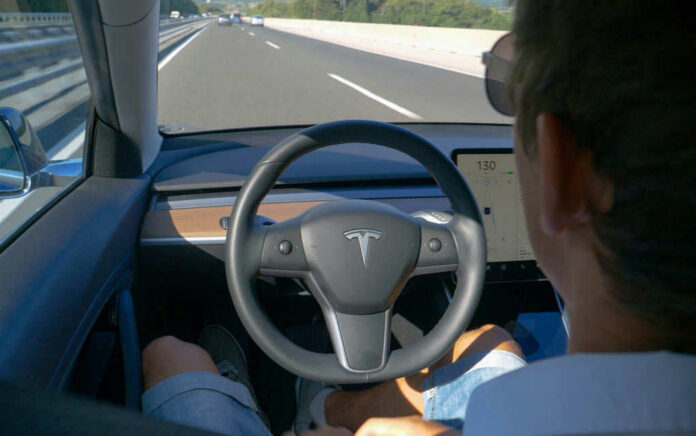
The modern car has quietly turned into a rolling smartphone, and the best evidence we have now says that shift to touchscreens is measurably undermining basic driving performance, not just irritating drivers but eroding the core skills that keep a vehicle in its lane.
Key Points
- High‑quality simulator research shows in‑car touchscreens produce substantially more lane drift and slower, less accurate control inputs while driving.
- Independent studies find touchscreen-based tasks routinely take far longer than physical buttons, extending eyes-off-road time into distances measured in fractions of a mile.
- The safety problem is not simply “big screens”: it is visual and cognitive multitasking designed into the interface, which current driver training and regulation only partially address.
- Crash‑rate epidemiology is still thin, but the behavioral data are strong enough that regulators in multiple countries have issued guidelines and some automakers are quietly reintroducing physical controls.
Touchscreens in Motion: What the Strongest Evidence Actually Shows
The clearest window into how touchscreens affect driving comes from a 2025 study by the University of Washington and Toyota Research Institute, run in a high‑fidelity simulator with drivers performing realistic touchscreen tasks while keeping a car on a virtual road. In that environment, drivers who interacted with the dashboard touchscreen drifted side‑to‑side in their lane 42% more often than when they simply drove, a direct measure of degraded lateral control. The same participants showed a 58% drop in touchscreen accuracy and speed while driving, meaning they were both slower and more error‑prone at hitting the right on‑screen targets once the vehicle was in motion.
When researchers added an extra memory task to raise cognitive load—closer to the mental juggling many drivers do in real traffic—touchscreen performance deteriorated further, by another 17%. Glances at the screen actually got shorter, but that did not make drivers safer; instead, they increasingly reached for controls before looking at them, a “hand‑before‑eye” pattern that rose from 63% to 71% as mental demands increased. That behavior sounds subtle, but in practice it means drivers are making more blind movements in the cabin while the car is still moving, raising the odds of incorrect inputs and delayed corrections if something unexpected happens ahead.
Because this was a simulator, it does not tell us exactly how many real‑world crashes can be pinned on touchscreens, and the authors are explicit about that limit. What it does provide is quantified evidence that the combination of driving and touchscreen use creates a genuine multitasking problem: the act of operating the screen competes directly with core vehicle control.
Buttons, Knobs, and the Cost of an Extra Second
The UW/TRI study is not an outlier. Over the last decade, multiple independent groups have focused on a simple question: how long does it take to perform common in‑car tasks on a touchscreen versus traditional physical controls, and what does that mean for eyes‑off‑road time? A Swedish study widely summarized in 2022 compared 12 cars at highway speeds, timing how long familiar drivers needed to adjust climate settings or seat heaters via touchscreens versus buttons. In that test, a 2005 Volvo with conventional knobs took roughly 10 seconds to complete a sequence of changes; a Tesla Model 3’s touchscreen took about 23 seconds, and another modern SUV stretched to 45 seconds for similar operations.
Even without the full dataset, the ordering is clear: moving these functions to touchscreens roughly doubled or more the task time for some vehicles, despite drivers already knowing their cars. At 68 mph, 10 seconds looking back and forth at controls corresponds to several hundred feet of potential inattention; 23–45 seconds translates into distances approaching or exceeding half a mile. The AAA Foundation’s own work on infotainment systems has found that certain screen‑based tasks can occupy drivers for up to 40 seconds, a figure that matches the Swedish timings and reinforces the core concern: when non‑driving tasks stretch beyond a few seconds, the car travels a long way while the driver’s visual and cognitive bandwidth is carved up.
Age magnifies the problem. AAA‑linked research has reported that older drivers can take 4.7 to 8.6 seconds longer than younger drivers to complete infotainment tasks, with more frequent and prolonged glances away from the roadway. Functionally, touchscreens impose a larger performance penalty on exactly the cohort already managing slower reaction times and more conservative driving patterns.
Are Big Screens Always Worse? A Nuanced Counterpoint
One well‑run study from the University of Iowa complicates the narrative that larger or more modern touchscreens are automatically more dangerous. In a simulator, researchers compared traditional displays with a new large touchscreen both handling similar functions, then looked at glance behavior, perceived workload, and basic lane‑keeping metrics. Drivers glanced slightly fewer times at the large touchscreen (3.6 glances versus 4.9), with each glance lasting longer (about 1.53 seconds versus 1.25 seconds), but the total time spent looking away from the road did not differ significantly between the two conditions.
Equally important, this study did not find statistically significant differences in lateral control, lane departures, or self‑reported workload between the traditional display and the large touchscreen. In other words, when the interface was carefully designed and the tasks constrained, simply enlarging the screen did not obviously worsen safety metrics, at least within the limits of that experiment. That finding does not refute the UW/TRI results, which examined multitasking under varying cognitive loads and a broader set of visual search behaviors, but it does signal that interface design and task choice matter; not every touchscreen is equally risky.
A complementary line of research has looked at whether training helps drivers cope with in‑car touchscreens. A ScienceDirect study on short pre‑drive instruction found that targeted training could reduce some distraction indicators, suggesting that familiarity and better mental models of the interface can mitigate, though not eliminate, the safety impact. That result supports what many experienced drivers report anecdotally: the first weeks with a new touch‑heavy car feel cognitively taxing, and some of that strain eases over time. The problem is that even trained, familiar drivers in the Swedish study still took considerably longer to perform tasks on touchscreens than on buttons.
Mechanism: Why Touchscreens Disrupt Driving So Effectively
The underlying mechanism is straightforward once you view driving as a limited‑capacity process. Safe driving relies on three resources: visual attention, cognitive bandwidth, and motor control. Physical knobs and buttons were designed so that once learned, they could be operated largely by feel; a driver might glance briefly but could rely on tactile feedback and spatial memory. Touchscreens strip away that tactile channel. Every operation becomes a visual search—locate the right icon, confirm its state, and tap with enough precision—performed on a flat plane that feels identical no matter where you touch.
The UW/TRI study makes this visible in its data on “visual search” time. Larger touchscreen targets did not meaningfully improve speed or accuracy because the bottleneck was not finger precision; it was the time drivers spent scanning the screen to find the right control. That scanning happens while the car is moving and competes head‑on with the need to monitor the roadway, read traffic, and plan vehicle maneuvers. When cognitive load rises—navigation decisions, conversation, or internal worries—the brain allocates less clean attention to the touchscreen task, but drivers often keep trying to do both, producing shorter glances and more premature hand movements that degrade both driving and interface performance.
Add in the modern tendency to centralize critical functions—wipers, lights, drive modes, even door latches—in screen menus, and the stakes change. A mis‑tap or delayed find is not just about climate comfort; it can affect visibility, vehicle behavior, or the ability to respond quickly when road conditions deteriorate.
Industry Incentives, Regulatory Lag, and a Growing Double Standard
Given this body of evidence, why are touchscreens nearly universal in new cars? Cost and styling are the blunt answers. Physical controls require individual components, wiring, and integration work; a large central display can host dozens of virtual buttons at marginal hardware cost, and it photographs beautifully in marketing materials. Safety advocates like the Center for Auto Safety have argued that this economic advantage, more than any proven safety gain, explains the industry’s move toward screen‑heavy interiors.
Regulation has not kept pace. In the United States, NHTSA issued voluntary guidelines in 2013 recommending that in‑vehicle tasks keep individual glances under two seconds and total task time under 12 seconds. Transport Canada has similar guidance aimed at limiting visual display distraction. But these are non‑binding: manufacturers can ignore them without direct consequence, and there is no standardized test protocol that consumers can see on a window sticker the way they see crash ratings or fuel economy.
At the same time, lawmakers have aggressively targeted smartphone use, banning handheld texting or social media scrolling in most jurisdictions. The legal argument is that phones produce unpredictable, attention‑grabbing notifications and app temptations, while in‑car systems are controlled and limited. That distinction is eroding. Major automakers now ship infotainment suites that mirror smartphone apps or even embed them directly—video conferencing, social feeds, and games accessible through the car’s own touchscreen. Safety messaging still condemns phones while largely ignoring functionally similar behavior on the dashboard. The behavioral data reviewed above strongly suggest this is a double standard.
Where the Evidence Is Thin and What Comes Next
Despite the strength of the behavioral metrics, there is a conspicuous gap: comprehensive crash‑rate epidemiology specifically linking touchscreen interactions to accident frequency. Simulator studies tell us how drivers drift, glance, and mis‑tap in controlled settings; AAA and similar organizations quantify task times and distraction windows; but police reports and national crash databases rarely capture whether a driver was interacting with an infotainment system in the seconds before impact.
That absence does not mean the risk is unreal; it means our measurement systems lag behind our technology. Regulatory agencies and research foundations could close this gap by adding structured fields for in‑vehicle system use to crash reports, then analyzing correlations over time. In parallel, independent audits across vehicle models could compare safety outcomes for cars that keep critical controls on physical interfaces versus those that bury them two taps deep in touch menus.
Meanwhile, the design and training evidence point toward pragmatic steps. Interfaces can be simplified, critical functions can return to tactile controls, and short, focused training sessions can help drivers build efficient mental maps of the remaining screens. European assessment programs have already pushed some manufacturers to reintroduce knobs for climate and volume after poor distraction scores, demonstrating that industry can pivot when safety pressure is specific enough.
For Drivers and Policymakers: Treat the Screen as a Safety System, Not Just a Gadget
For individual drivers, the takeaway is not that every touchscreen must be avoided at all costs, but that any non‑driving task on a screen should be treated with the same seriousness as a text message: kept brief, deferred whenever possible, and configured before the car moves. Tasks that can wait until a red light or a parking lot, should. Voice controls and steering‑wheel buttons deserve more attention as practical workarounds, though they bring their own cognitive demands.
For policymakers and automakers, the evidence now assembled is strong enough to justify a shift in design philosophy. Touchscreens are here to stay, but the question is what they are asked to do while the vehicle is in motion. The safest path is not to perfect the illusion that drivers can multitask indefinitely; it is to reduce the need to multitask at all. That means fewer screen‑dependent operations on the move, clearer separation between driving essentials and convenience features, and an honest alignment between the way we regulate phones and the way we regulate the dashboards that increasingly mimic them.
Sources:
washington.edu, cedtechnologies.com, actslaw.com, youtube.com, reddit.com, facebook.com, sciencedirect.com, autospies.com, pubs.lib.uiowa.edu
© totalconservative.com 2026. All rights reserved.