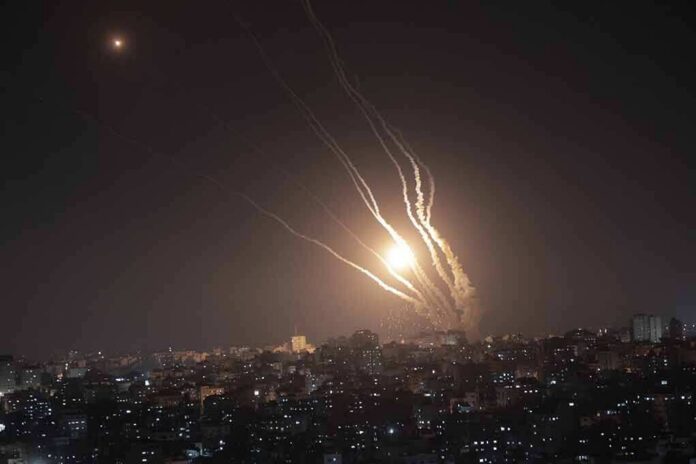
Ukraine says Russia launched more than 110 missiles and drones in an 18-hour overnight barrage that struck six cities, killed civilians, and tested air defenses at scale.
Story Snapshot
- Ukraine reported over 110 missiles and drones launched in a sweeping overnight attack.
- Strikes hit at least six cities, including the capital, Kyiv, over about 18 hours.
- Officials recorded multiple civilian deaths during the barrage.
- Ukraine’s Air Force called it among the largest since a 2022 mass strike.
What Ukraine Reported About The Overnight Barrage
President Volodymyr Zelenskyy said Russia fired more than 110 missiles and drones during a nightlong attack across Ukraine. He said the strikes hit six cities from east to west, including Kyiv, and lasted around 18 hours. Initial reports listed several civilian deaths and injuries. The Ukrainian Air Force said the scale ranked among the largest since Russia’s full invasion. Officials described waves of launches, with some strikes spaced in intervals to strain responders.
Ukrainian authorities later described a similar pattern in another large-scale strike, saying missiles arrived in groups every 20 to 30 minutes. That timing, they said, made firefighting and repairs harder between waves. Officials also cited a mix of missile types, including a significant ballistic component in a separate broad assault reported later on. These descriptions help explain how serial waves can overwhelm defenses and emergency crews in cities and across regions.
Scale And Civilian Toll Compared With Past Strikes
Ukraine’s Air Force said the overnight strike count topped the 96 missiles launched in a major 2022 barrage. That comparison is based on the reported figure of more than 110 missiles and drones this time. Officials said the attack struck population centers and key urban areas. Early counts reported at least seven to eight civilians killed. These numbers may change after officials complete site checks and confirm identities, which often takes days in active conflict zones.
Analysts and aid groups have tracked a broader pattern of long-range attacks against cities, energy grids, and industry. Research from the Center for Strategic and International Studies says Russia has focused repeated salvos on infrastructure to raise social and economic pressure. These salvos are often timed for high-demand seasons, like winter, when damage to power or heat has a bigger impact on daily life. That mix of targets raises risks for civilians who live near key networks.
Why The Strike Matters Beyond The Battlefield
Large, spaced-out salvos can drain air defense stocks, force civilians into shelters for long periods, and slow emergency crews. They can also disrupt power, heat, and transport. That hurts work, schools, hospitals, and small businesses. United Nations monitors have said that confirmed civilian casualty counts likely understate the true toll, because access limits slow verification. The result is a grinding strain on daily life that spreads fear, drives up costs, and deepens the social divide.
🇺🇦 Russia hit three Kyiv bridges and Ukraine's power grid overnight in one of the largest attacks of the war, hours after Vladimir Putin, Donald Trump and Xi Jinping released a joint "peace declaration" in Shenzhen.
Russia launched more than 400 attack drones and over 110… pic.twitter.com/Ahz15KAMno
— The Tectonic (@thetect0nic) November 20, 2026
For Americans watching from home, the lesson is simple but serious. Modern wars use missiles and drones to reach far beyond the front lines. That leaves families, workers, and the elderly in harm’s way. It also shows how fragile critical systems are when leaders fail to protect them or play politics with basic needs. Many Americans feel a similar worry here at home: when crises hit, ordinary people pay first while elites argue and delay.
What To Watch Next
Ukrainian officials will release fuller damage reports as they verify sites, casualties, and debris. Watch for details on which targets were hit, how many missiles were intercepted, and how fast power and transport return. Also track shifts in Russian tactics, such as the share of ballistic versus cruise missiles, and the timing of waves. These details show whether defenses are keeping up and whether civilians face higher risk in the weeks ahead.
Sources:
insiderpaper.com, en.interfax.com.ua, ground.news, economictimes.indiatimes.com, devdiscourse.com, nv.ua
© totalconservative.com 2026. All rights reserved.