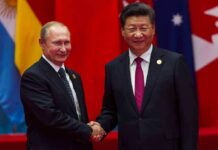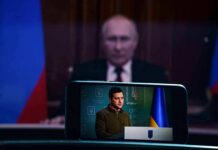
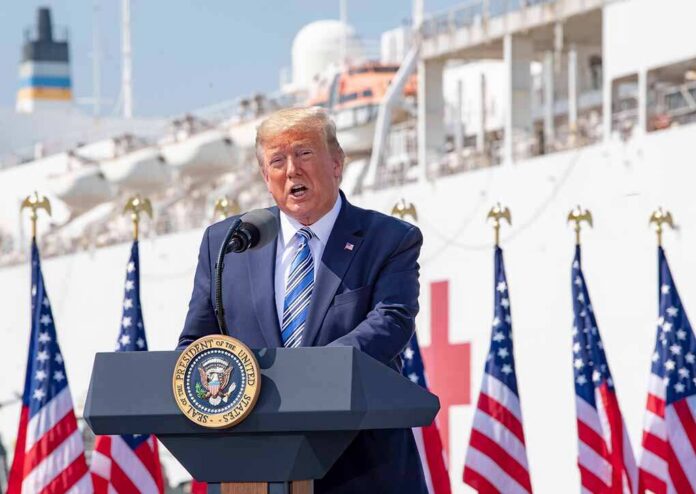
President Trump greeted Russian President Vladimir Putin as “my friend” during a historic three-way summit with Chinese President Xi Jinping, marking Putin’s most high-profile return to world diplomacy since Russia invaded Ukraine in 2022.
Quick Take
- Trump, Putin and Xi held a trilateral meeting in Shenzhen, China, on November 19, 2026.
- Trump greeted Putin by saying “He’s my friend!” in footage captured by Russian media.
- The 90-minute bilateral talks covered Ukraine, Iran, nuclear weapons, trade, and artificial intelligence.
- The leaders issued a symbolic “peace declaration” but struck no formal arms-control deal.
- The Kremlin said Putin left the meeting in an “excellent” mood.
Trump Brings Three World Powers to the Table
President Trump sat down with Putin and Xi in Shenzhen on November 19, 2026, for the first-ever three-way talks between the leaders. Before the trilateral session, Trump told Xi that the United States and China should work together to help end the war in Ukraine, setting a clear goal for the diplomacy that followed. The meeting stretched roughly 90 minutes and touched on some of the biggest security issues facing the world.
Topics on the table included the wars in Ukraine and Iran, nuclear weapons, trade tensions, and artificial intelligence. For a president who campaigned on ending costly foreign conflicts and restoring American strength through dealmaking rather than endless war, getting Russia and China in the same room to discuss Ukraine counts as a tangible step most predecessors never managed.
“He’s My Friend”: The Moment Everyone Noticed
When Putin walked into the room, Trump reportedly asked, “Who is he?” then answered his own question: “He’s my friend!” Russian media cameras caught the whole exchange. It is not the first time Trump has used that word for Putin. Back at the 2019 G20 summit in Osaka, Trump told reporters, “We’ve had great meetings,” and predicted “a lot of very positive things” from the relationship.
That history has not always been smooth. Trump canceled a planned 2018 meeting with Putin after Russia seized Ukrainian naval vessels near Crimea, and ties between Washington and Moscow were strained for years over Crimea and Syria. The friendly greeting in Shenzhen stands in sharp contrast to that rockier chapter, showing how fast the temperature between these two leaders can shift.
A Declaration Without a Deal
The three leaders came out of Shenzhen with a “peace declaration,” but no arms-control agreement and no signed settlement on Ukraine. The Kremlin described the mood as upbeat, saying Putin left the talks “excellent” and that Ukraine was a central topic of discussion. Still, the available reporting makes clear the declaration was symbolic, not an operational plan with timetables or enforcement.
Reuters reported that despite the warm handshakes and smiles, the three sides remain far apart on the substance of ending the war. That gap matters. A friendly photo opportunity is not the same as a ceasefire, a prisoner exchange, or a withdrawal timeline, and conservative voters who want this war over will be watching for those concrete next steps.
How This Fits the Bigger Picture
American presidents have met with Russian leaders for decades, and the record is mixed. Some summits built real trust and led to landmark arms deals like SALT, the ABM Treaty, and START. Others produced little beyond a handshake and a photo. Shenzhen falls somewhere in between for now: real engagement between nuclear powers, but no signed commitments yet on paper.
What makes this summit different is the setting. Putin has been treated as an outcast across much of the West since 2022, and this marked his most visible return to the global stage. Whether or not people like Putin personally, getting him and Xi talking directly with an American president about ending the Ukraine war beats the alternative of no talks at all.
"Rather than restoring America’s centrality in great power diplomacy, the Trump-Xi-Putin trilateral in Shenzhen may underscore how far Washington’s position has eroded since the triangular diplomacy of the 1970s" https://t.co/qHwiHk5gMo
— Transatlantic Policy Center 🇺🇦 (@AU_EuropeCenter) November 19, 2026
President Trump has long argued that personal relationships with foreign leaders can unlock deals that bureaucrats and career diplomats cannot. Shenzhen gave him another chance to test that theory on the world’s biggest stage. The real measure of success will come later, when and if Ukraine sees an actual ceasefire, not just another round of warm words in front of the cameras.
Sources:
youtube.com, reuters.com, rmb.reuters.com, yahoo.com
© totalconservative.com 2026. All rights reserved.